


“Towards nature Positive Mangroves”: ZMT researchers share their impressions from the 7th Mangrove, Macrobenthos and Management Conference (MMM7)
Dieser Text ist derzeit nur auf Englisch verfügbar
The 7th Mangrove, Macrobenthos and Management Conference (MMM7) brought together scientists, practitioners, and policymakers from around the world in Ishigaki, Okinawa, Japan (1 - 5 July 2026) under the theme “Towards Nature Positive Mangroves.”
Building on a conference series that has connected the global mangrove community since 2000, MMM7 provided a platform to share the latest scientific advances, exchange practical experiences, and strengthen international collaboration for the conservation, restoration, and sustainable management of mangrove ecosystems. As one of the world's most productive coastal habitats, mangroves play a vital role in supporting biodiversity, protecting coastlines, and mitigating climate change.
Discover the key insights and takeaways from ZMT researchers below.
Prof. Dr. Martin Zimmer, Head of Programme Area Ecosystem Co-Design and WG Mangrove Ecology:
"Once again, the MMM conference proved to be one of the most rewarding and inspiring conferences for me, bringing together researchers and scientists, practitioners and managers from various regions of the world. While I personally still miss a stronger focus on (experimental) ecology, the attention had shifted from large-scale remote-sensing and modelling of mangrove forests and their distribution at MMM6 in Colombia to eDNA-based biodiversity surveys at MMM7. It again became obvious that collaboration – across disciplines, across sectors, across continents – is key to rendering scientific and other types of knowledge a valuable baseline and support for mangrove forest conservation, management and governance, as well as successful (re-)establishment of mangrove stands that provide ecosystem services to local communities and humankind worldwide.
The IUCN SSC Mangrove Specialist Group (MSG) used the occasion of MMM7 for an in-person meeting. The major outcomes are an agreement on the definition of what a "mangrove" is (and what not) and the resulting list of mangrove species, as well as the corresponding prospect of the Red List of mangrove species being ready by mid next year; we further discussed changes in the structure and organisation of the MSG, including the announcement that the following MMM conferences will be jointly organized by the local hosts and the MSG."
Dr Véronique Helfer, Senior Scientist, WG Mangrove Ecology:
"The conference showcased the rapid advances in mangrove research. Presentations covered environmental DNA (eDNA) for biodiversity monitoring, satellite- and drone-based mapping, improved Blue Carbon accounting through greenhouse gas measurements, and mangrove responses to sea-level rise, extreme weather, and wildfires. I contributed with a talk focused on closing knowledge gaps in mangrove functional traits through the Mangrove Traits Global Initiative (MANTRA), an international collaboration that I lead, which was very well received, with already several new members joining the international team.
One of the most interesting insights for me, was that mangrove tree trunks, in addition to soils and aerial roots, can contribute to greenhouse gases such as CO₂, CH₄. These new measures will improve carbon balance calculations and help scientists and policymakers better assess mangroves as nature-based solution for climate change mitigation. The findings are particularly relevant to ZMT's work within the sea4soCiety project.
Another highlight was the use of the LiDAR scanner integrated into iPhone Pro models to create detailed 3D maps of sediment surfaces and mangrove root systems. This accessible technology opens new opportunities to study ecosystem resilience, and how mangrove forest can contribute to coastal protection, and climate adaptation.
The conference also showed that research on mangrove functional traits is moving forward. New molecular studies from Japan and Brazil are revealing how genetics, epigenetics, and environmental conditions shape trait variation; this knowledge which will help us identifying species and traits to select for ecosystem co-design for climate change adaptation.
Overall, MMM7 highlighted the growing integration of ecology, evolution, remote sensing, climate science, and conservation, leaving me optimistic about future discoveries and the next conference in New Caledonia in 2029."
Moise Leance Sagbohan, Doctoral Candidate, WG Mangrove Ecology
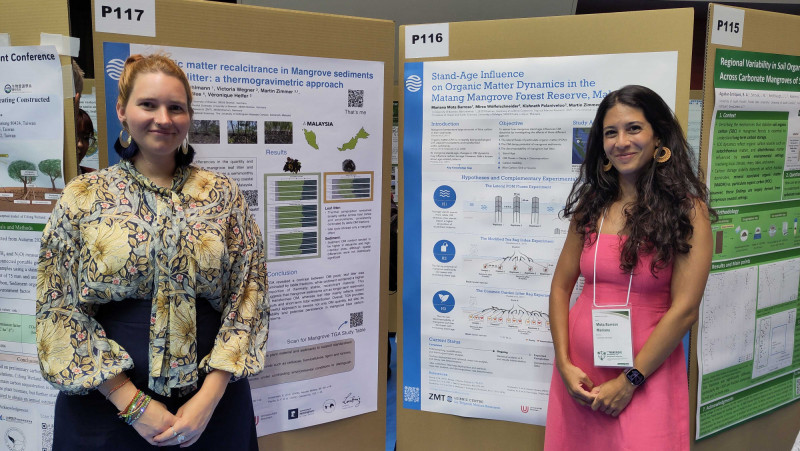
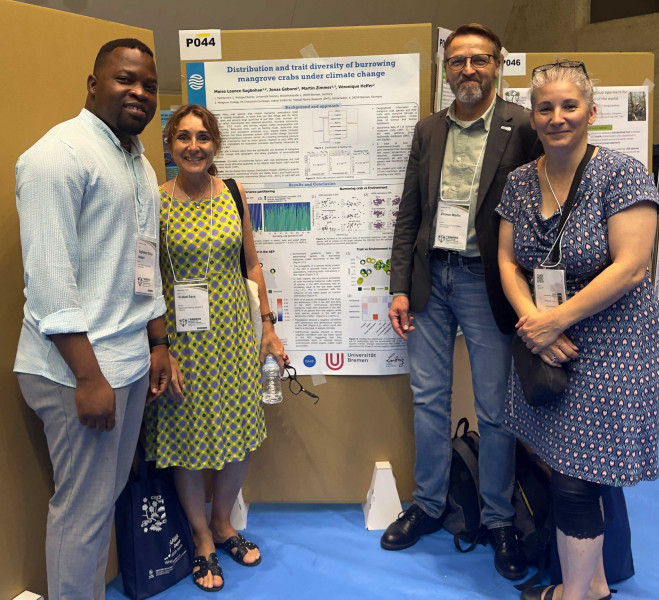
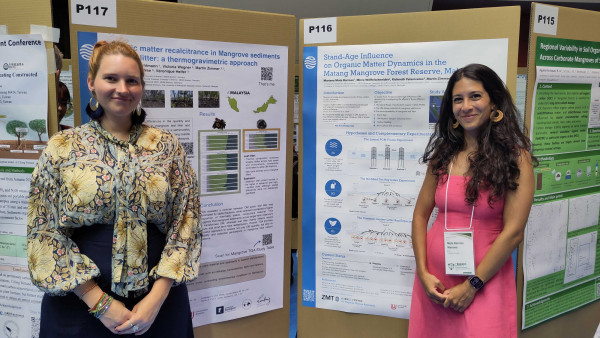
I really enjoyed participating in the MMM7, well-organized conference. I presented (poster) parts of my research on modelling mangrove crab species traits and their global distribution, which is essential for biodiversity conservation, particularly under environment pressures driven by climate change. The most interesting feedback came from two recognized Experts in this field, who confirmed that my preliminary results reflected their field observations, which is a good indication that our model is performing well, although some improvements are still needed to avoid overfitting related to biotic interactions. In addition, I had a brief but enriching meeting with the Members of my doctoral panel who were attending the conference (3 out of 4), and I networked with other Researchers with a view to potential collaborations, notably as a GLOW (Global Wetlands Project) correspondent for Benin, specifically for collecting crab data for the MBCAM app (Mangrove Biodiversity Condition Action Map application). I finally returned from my first MMM conference, with new perspectives and renewed motivation to advance my research"
PD Dr. Tim Jennerjahn, Head of Programme Area Coastal Transformation and WG Ecological Biogeochemistry:
"MMM7 was once again an outstanding conference. It was extremely well organized and took place in a very welcoming, warm and inclusive atmosphere. There were excellent scientific presentations by researchers of all ages from all over the world. Over the past twenty years, mangroves have received much greater attention in science, politics and society. This is due in large part to the community of scientists represented at the conference. Many of the ground-breaking findings of this period in mangrove research and conservation can be attributed to the intensive interdisciplinary collaboration amongst those involved in the MMM conferences. MMM7 was another highlight in this series."
Alejandro Ramón Plazas, Doctoral Candidate, WG Mangrove Ecology:
"One of my main takeaways from MMM7 was that mangrove forests are even more complex ecosystems than we often assume. Their biodiversity and the ecosystem services they provide are shaped not only by anthropogenic pressures but also by their natural biophysical characteristics. It was also exciting to see how emerging tools such as eDNA metabarcoding are expanding our ability to assess the diversity of mangrove-associated communities and offering new opportunities to evaluate human impacts on these ecosystems. Finally, I found it interesting how differently ecosystem services are assessed across studies, and how the methods we use can influence what we value, prioritize, and at the end, what we choose to manage and protect."
Tobias Poprick, Guest Scientist, WG Mangrove Ecology
"MMM conferences actually don’t feel like ‘normal’ conferences at all – they're more like a gathering of friends and colleagues who all share the same passion and dedication to mangroves. These conferences often lead to important collaborations and promising scientific projects, fostering a united effort to the protection of mangroves. It has been a privilege to once again attend an MMM conference and to be a tiny part of the organizing team as a videographer."
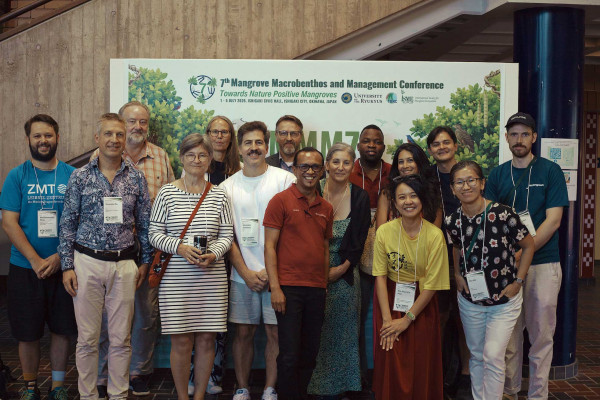


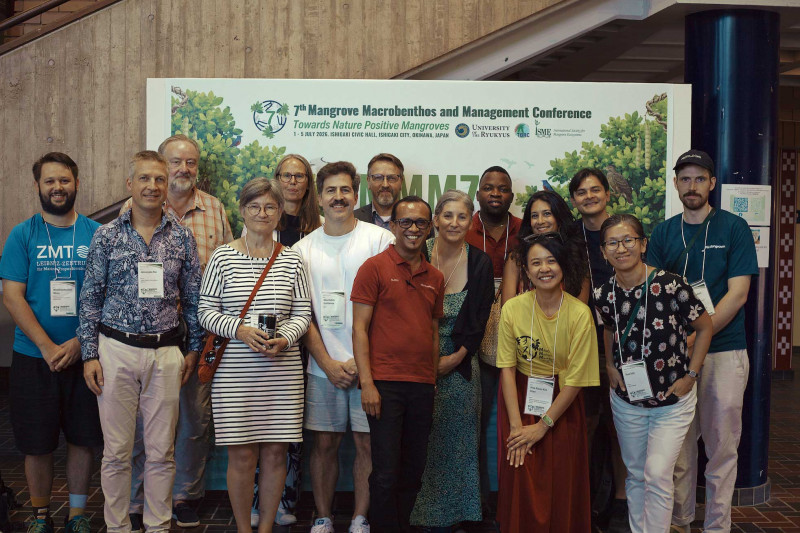
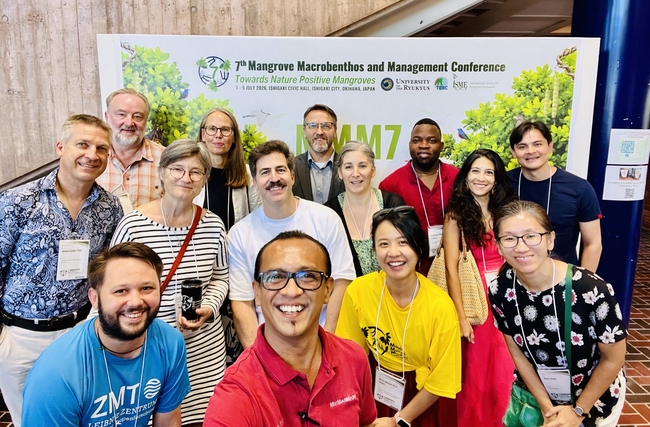
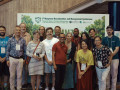
ZMT and ZMT alumni at the MMM7 (from left to right): Mirco Wölfelschneider (PA4), Tim Jennerjahn (PA3), Uta Berger (ZMT alumni), Inga Nordhaus (ZMT alumni), Guilherme Abuchahla (ZMT alumni), Martin Zimmer (PA4), A. Aldrie Amir (former NAM fellow), Véronique Helfer (PA4), Moise Leance Sagbohan (PA4), Mariana Mota Barroso (in the back; PA4), Alison Kim Shan Wee (in the front; former NAM fellow), Ramón Alejandro Plazas Gómez (PA4), Amy Than (former NAM fellow), Tobias Poprick (PA4). Daisy Ruhlmann (PA4) is missing on this picture. | Photo: Kingsley John De Los Santos


 Kontakte
  Programmbereiche
  Arbeitsgruppen