



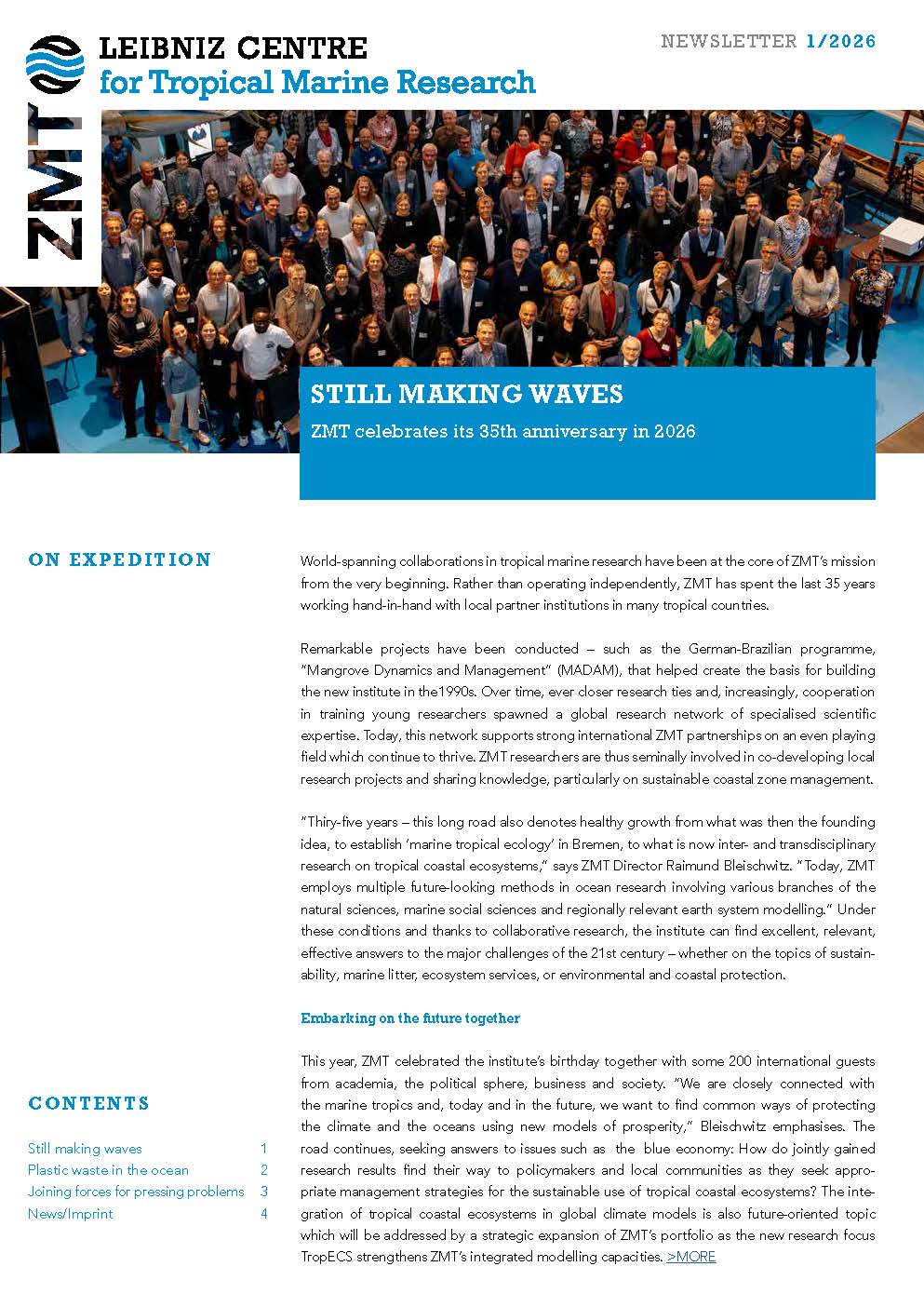
ZMT Newsletter #01/2026
This edition of our newsletter is a special one, as ZMT celebrates its 35th anniversary. Since its beginnings, international collaboration has been at the heart of our work. Today, our global network of partners spanning from continues to shape research on tropical coastal ecosystems and helps us address some of the major environmental challenges of our time.
You can watch highlights of our celebrations here.
One of these challenges is plastic pollution in the ocean. We take a closer look at research on a new generation of biodegradable plastics and ask how innovative materials could become part of the solution to the growing problem of marine plastic waste.
International cooperation is also at the centre of COLDEMAR, a new Colombian-German knowledge platform for tropical marine biodiversity and climate change. ZMT’s Sonia Bejarano and Fernando Zapata from Universidad del Valle talk about their plans to build a long-term bridge between researchers in Colombia and Germany – from joint research projects to training opportunities for early-career scientists.
Finally, our news section offers a glimpse into some of ZMT’s latest research and activities – from new international projects on climate adaptation and coastal biodiversity to sustainable marine food sources and an award for outstanding research on groundwater.
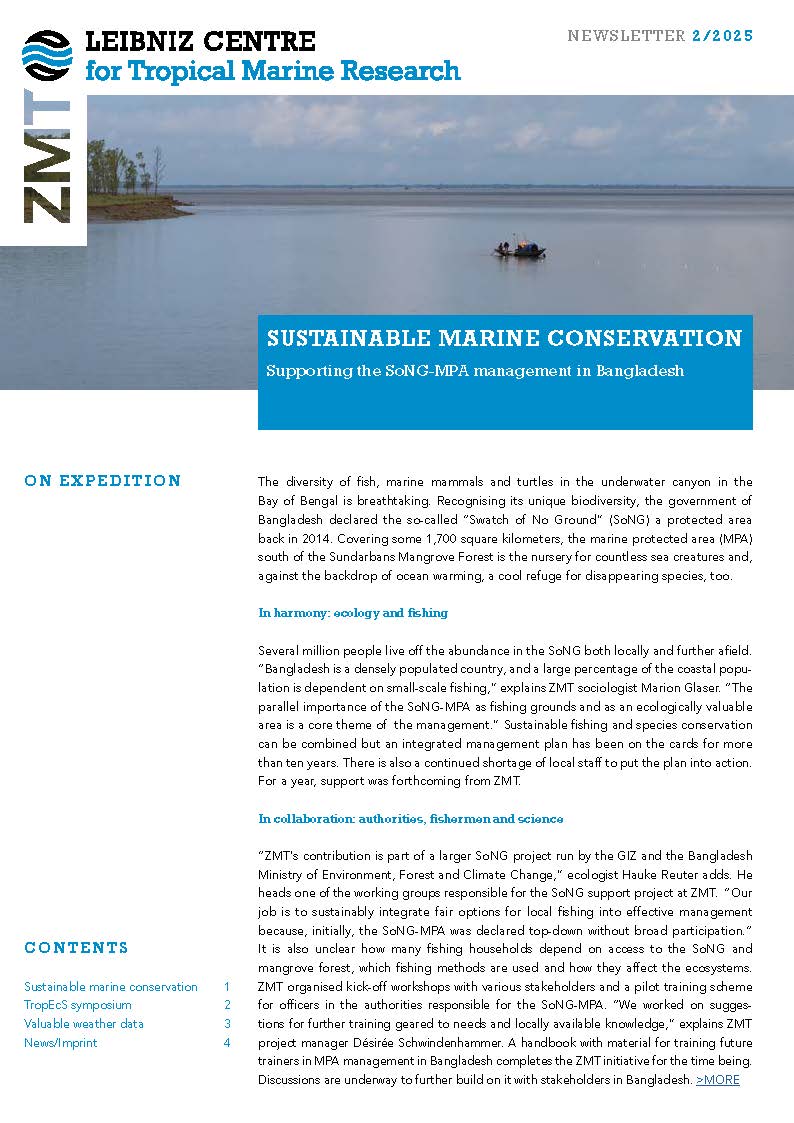
ZMT Newsletter #02/2025
This edition of our newsletter takes you to a unique marine protected area south of the Sundarbans Mangrove Forest in Bangladesh – the “Swatch of No ground”. Here, ZMT has been contributing to the sustainable integration of fair and viable options for local fishers into the management of the MPA.
Closer to home, the spotlight was on a three-day symposium that marked the official launch of our new institute extension TropEcS. More than 100 international experts, early-career researchers, colleagues, and partners from tropical regions – stretching from Indonesia to Peru – gathered in Bremen to discuss and explore how tropical coastal ecosystems can be better integrated into global Earth System Models. With this symposium, ZMT took an important first step towards strengthening its modelling capacities and highlighting the crucial role of coastal and marine processes in understanding global change.
Earth system modelling – and climate research in particular – depends on accessible, high-quality data. In this issue, two of our climate scientists share insights into their work collecting and exchanging weather data.
Finally, our news section offers an overview of ZMT’s latest activities – from partnerships and capacity development to research updates and participation in high-level conferences such as UNOC3.
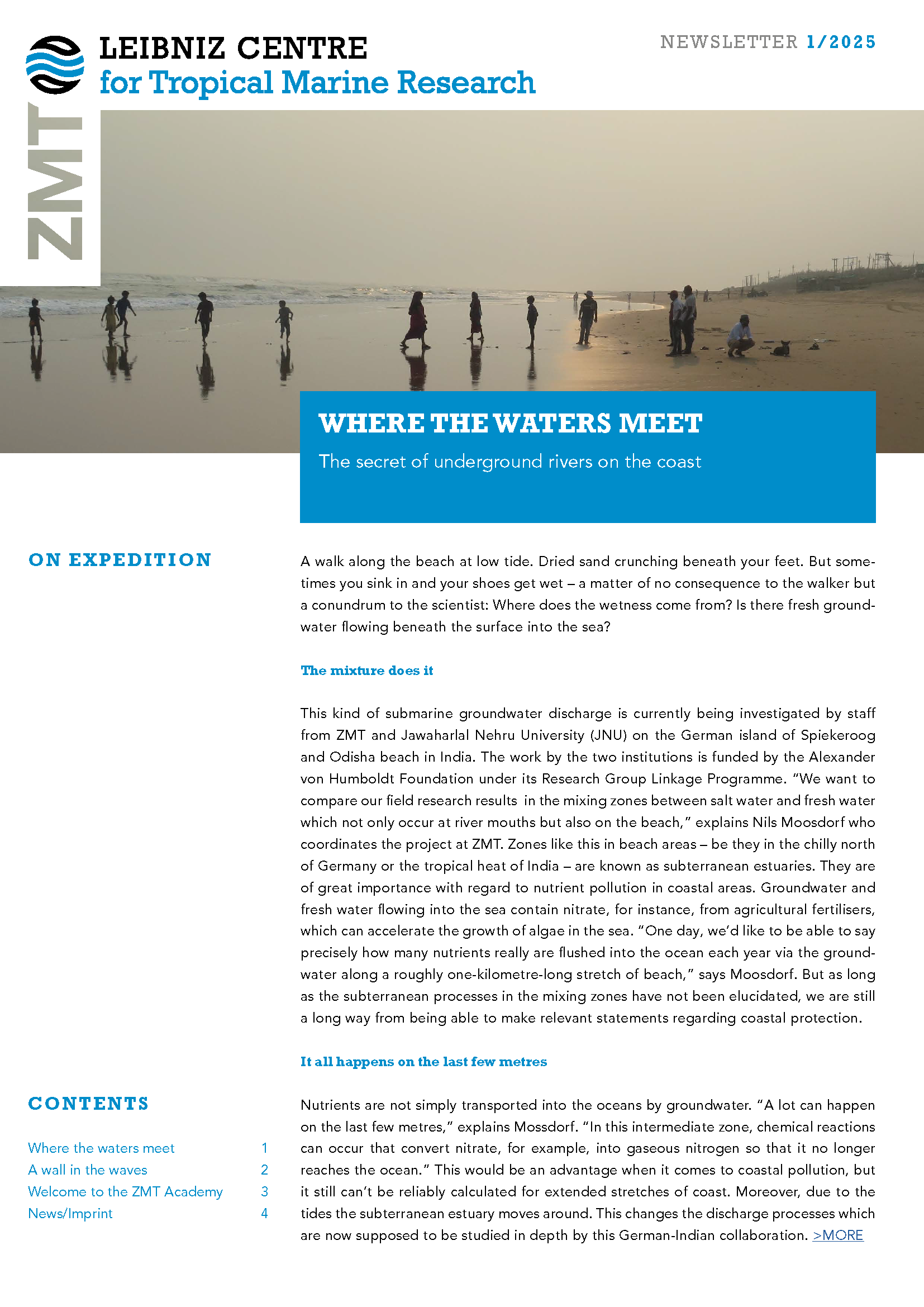
Where the waters meet
The secret of underground rivers on the coast
A walk along the beach at low tide. Dried sand crunching beneath your feet. But some-
times you sink in and your shoes get wet – a matter of no consequence to the walker but
a conundrum to the scientist: Where does the wetness come from? Is there fresh ground-
water flowing beneath the surface into the sea?
ZMT Newsletter #01/2025
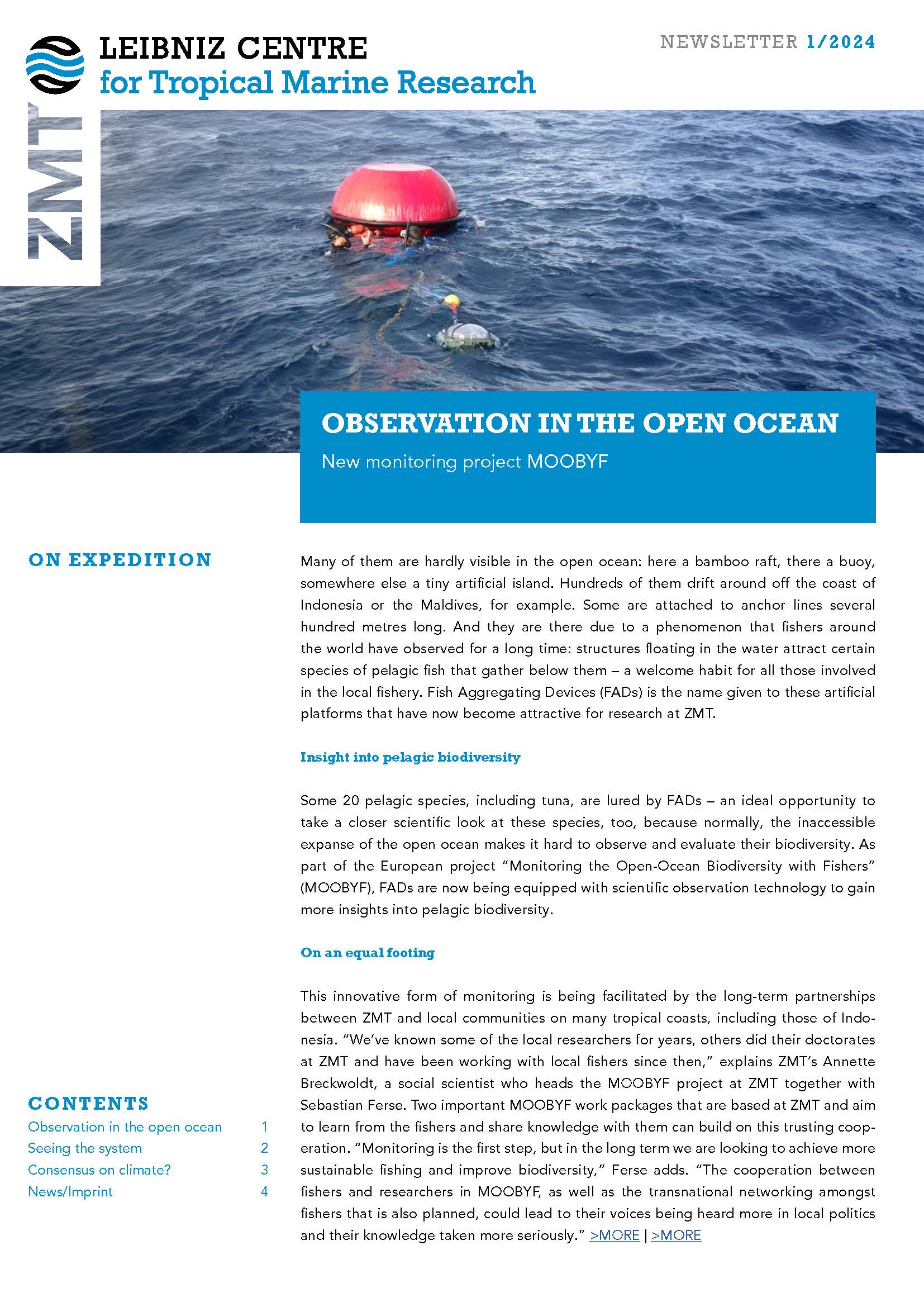
Observation in the open ocean
New monitoring project MOOBYF
Many of them are hardly visible in the open ocean: here a bamboo raft, there a buoy,
somewhere else a tiny artificial island. Hundreds of them drift around off the coast of
Indonesia or the Maldives, for example. Some are attached to anchor lines several
hundred metres long.
ZMT Newsletter #01/2024
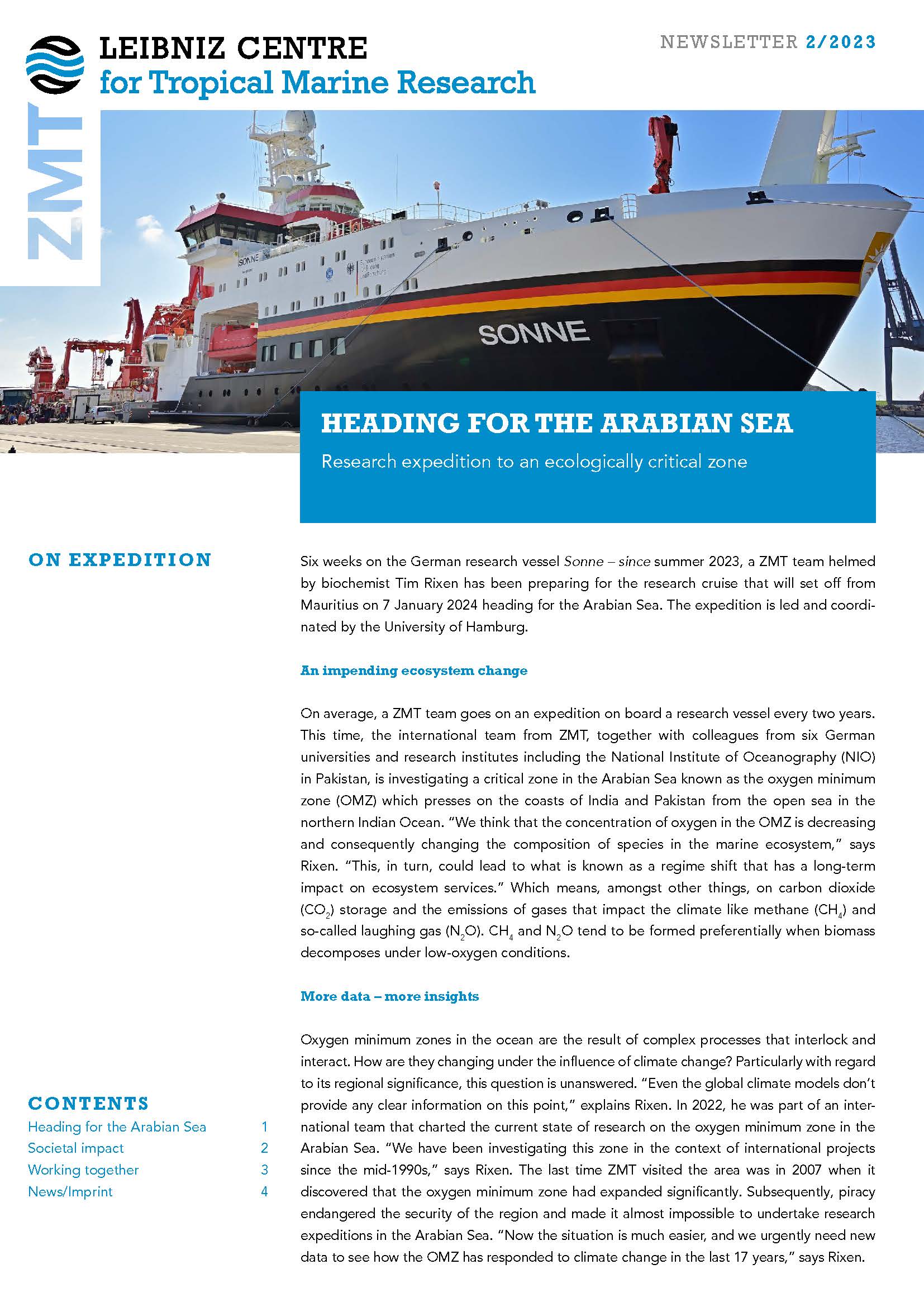
Heading for the Arabian Sea
Research expedition to an ecologically zone
Six weeks on the German research vessel Sonne – since summer 2023, a ZMT team helmed
by biochemist Tim Rixen has been preparing for the research cruise that will set off from
Mauritius on 7 January 2024 heading for the Arabian Sea. The expedition is led and coordi-
nated by the University of Hamburg.
ZMT Newsletter #02/2023

Life in a Plastic Sea
An ecosystem facing dangerous ‘colourful’ challenges
Marine litter and plastic pollution are an ever increasing problem for our oceans. Images
of fish bellies stuffed with plastic tell us the drama is reaching a crisis – but not every fish eats
this poisonous, colourful stuff
ZMT Newsletter #01/2023
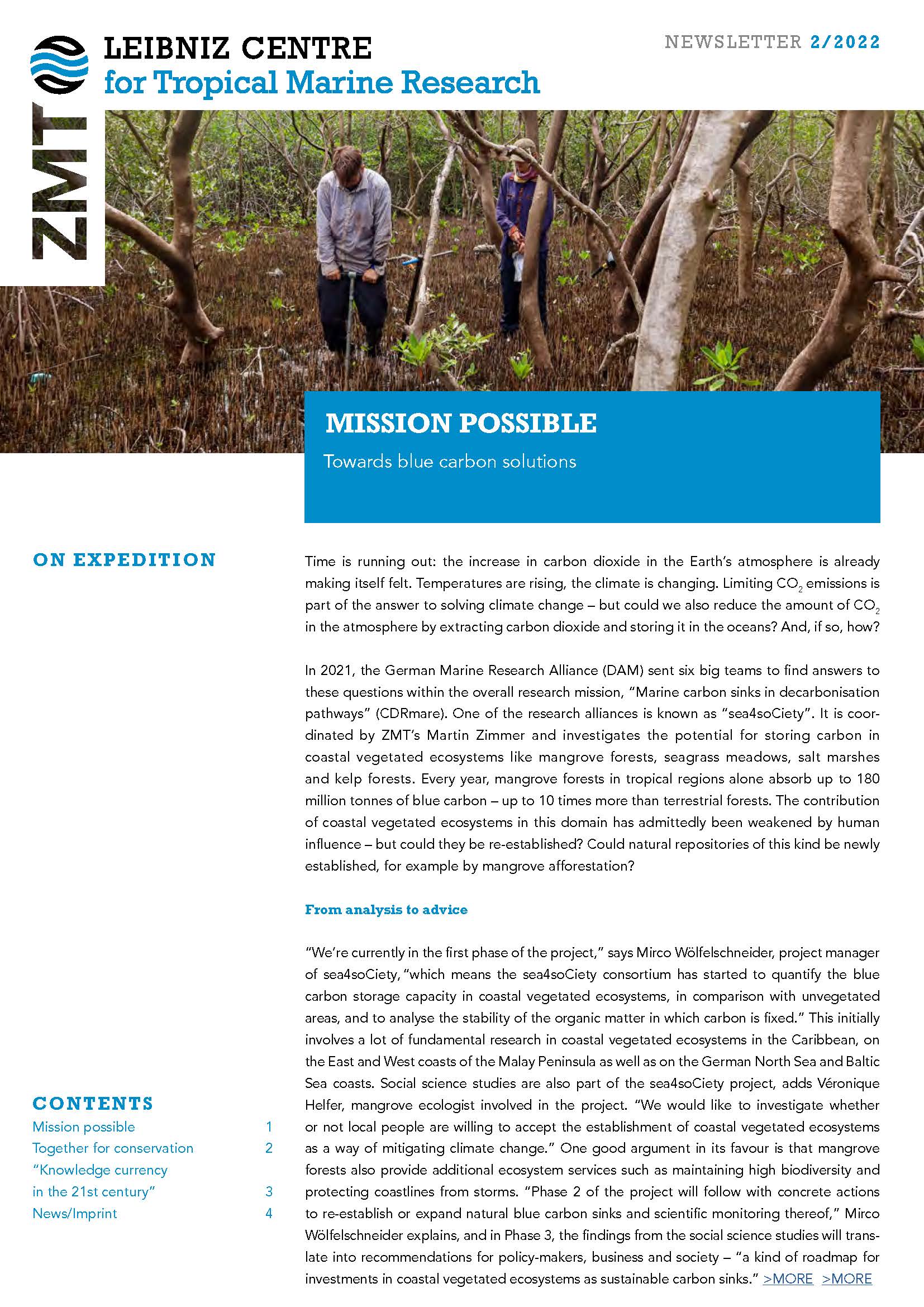
Mission Possible
Towards blue carbon solutions
Time is running out: the increase in carbon dioxide in the Earth’s atmosphere is already
making itself felt. Temperatures are rising, the climate is changing. Limiting CO2 emissions is
part of the answer to solving climate change – but could we also reduce the amount of CO2
in the atmosphere by extracting carbon dioxide and storing it in the oceans? And, if so, how?
ZMT Newsletter #02/2022

"We need to think environment and development as one."
Raimund Bleischwitz - the new scientific director of ZMT
For sustainability researcher Raimund Bleischwitz, climate change is the central challenge of
our time. „In ten years’ time, I would like to see the global sustainability goals achieved,” says
ZMT’s new scientific director. By that time, man-made global warming should be limited, the
1.5-degree target should be within reach if possible, and 30 per cent of marine ecosystems
should be protected in a sustainable way and in line with the needs of coastal communities.
ZMT Newsletter #01/2022
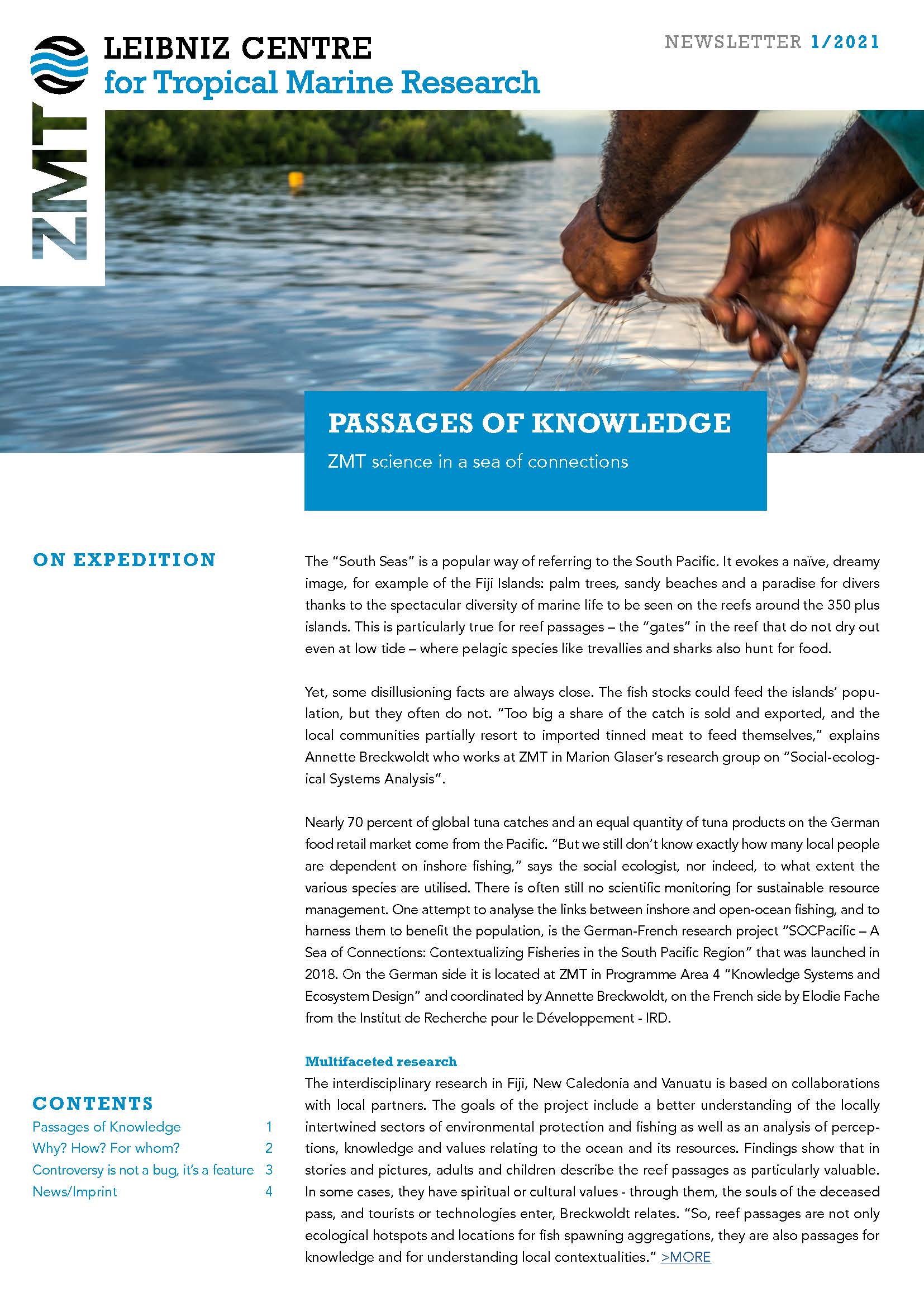
Passages of Knowledge
The “South Seas” is a popular way of referring to the South Pacific. It evokes a naïve, dreamy
image, for example of the Fiji Islands: palm trees, sandy beaches and a paradise for divers
thanks to the spectacular diversity of marine life to be seen on the reefs around the 350 plus
islands. This is particularly true for reef passages – the “gates” in the reef that do not dry out
even at low tide – where pelagic species like trevallies and sharks also hunt for food
ZMT Newsletter #01/2021
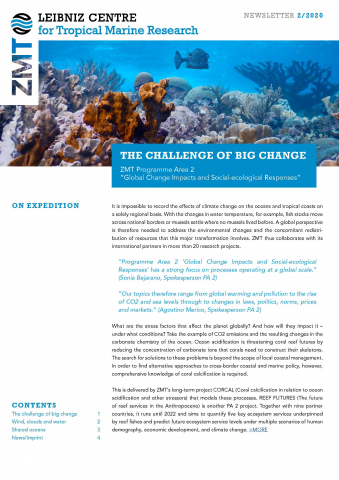
The Challenge of Big Change
ZMT Programme Area 2 - “Global Change Impacts and Social-ecological Responses”
It is impossible to record the effects of climate change on the oceans and tropical coasts on
a solely regional basis. With the changes in water temperature, for example, fish stocks move
across national borders or mussels settle where no mussels lived before.
ZMT Newsletter #02/2020

FOOD FOR THE FUTURE
Towards sustainable nutrition worldwide
The figures for fish caught around the world are falling – as the statistics published by the
United Nations’ Food and Agriculture Organisation (FAO) over recent years have revealed.
But in the future, food from the ocean will be more important than ever if we are to meet
the protein requirements of a growing world population.
ZMT Newsletter #01/2020
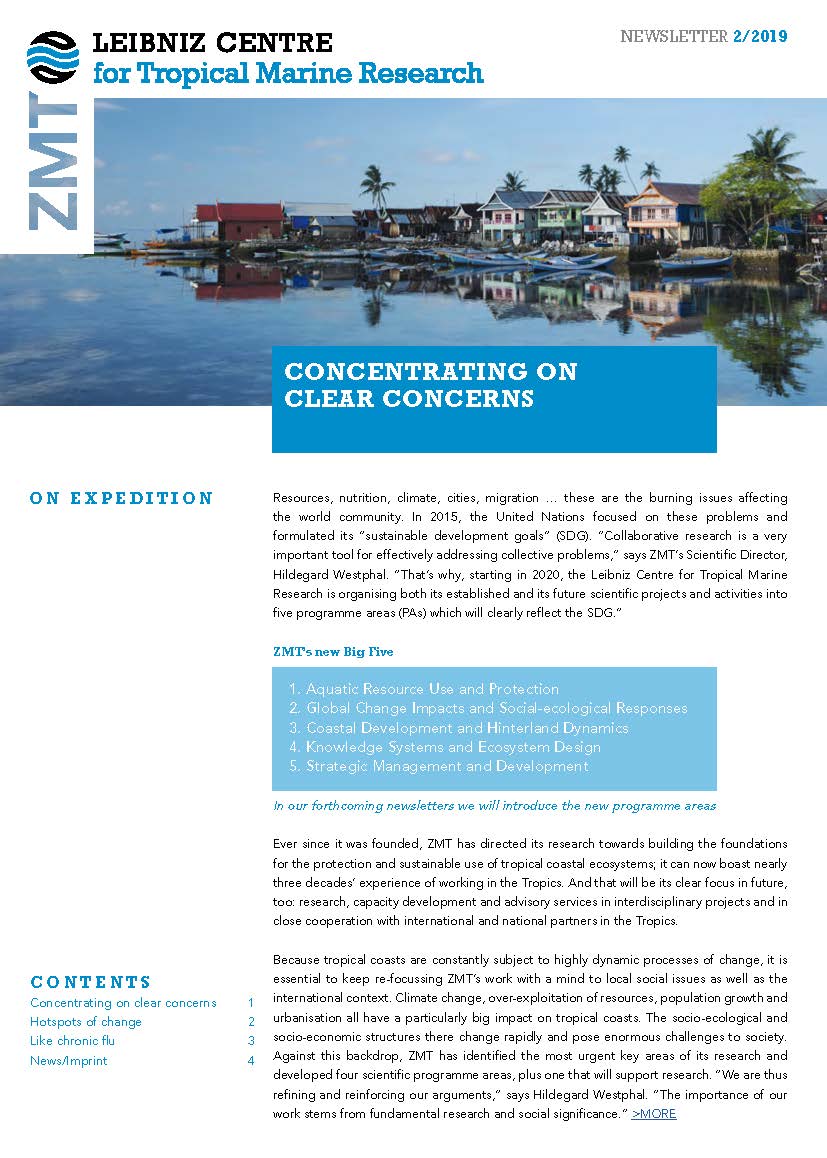
Concentrating on Clear Concerns
Resources, nutrition, climate, cities, migration … these are the burning issues affecting
the world community. In 2015, the United Nations focused on these problems and
formulated its “sustainable development goals” (SDG).
ZMT Newsletter #02/2019
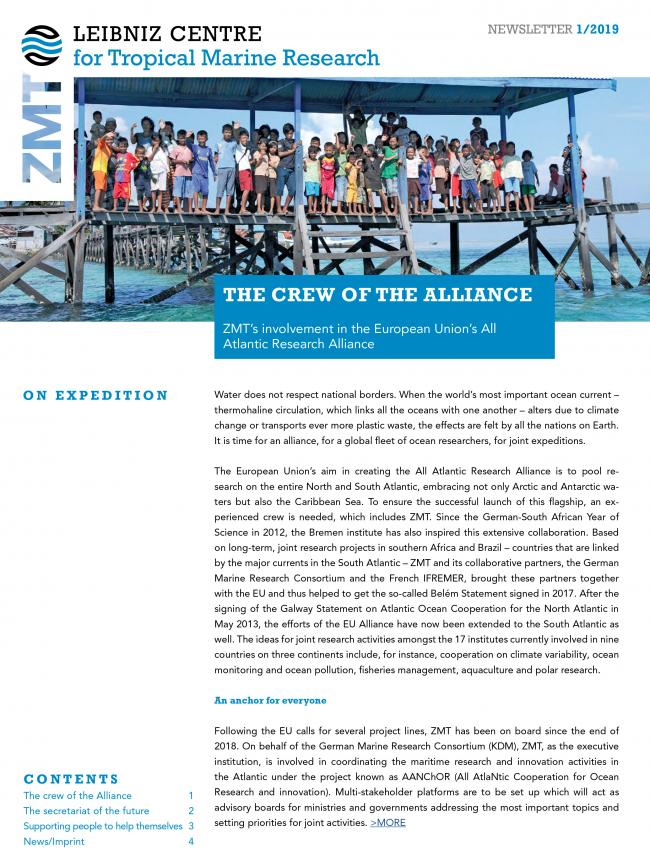
The Crew of the Alliance
ZMT’s involvement in the European Union’s All Atlantic Research Alliance
Water does not respect national borders. When the world’s most important ocean current –
thermohaline circulation, which links all the oceans with one another – alters due to climate
change or transports ever more plastic waste, the effects are felt by all the nations on Earth.
It is time for an alliance, for a global fleet of ocean researchers, for joint expeditions.
ZMT Newsletter #01/2019

Drowning Megacities
How humans adapt when the water rises
Three megacities by the sea: Singapore, Jakarta, Manila. What will happen to their 40-mil-
lion-odd inhabitants when sea levels rise? “Singapore has been preparing for this threat-
ening scenario for years with standardised infrastructure measures,” says Anna-Katharina
Hornidge, head of ZMT’s Social Science Department.
ZMT Newsletter #02/2018
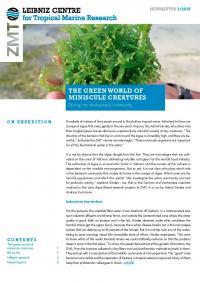
The Green World of Miniscule Creatures
Diving into the bacteria community
Hundreds of metres of lines swash around in the shallow tropical water. Attached to them are
clumps of algae that sway gently in the sea swell. Anyone, like Astrid Gärdes, who dives into
their tangled green leaves discovers a spectacularly colourful society of tiny creatures. “The
diversity of the bacteria that live on and around the algae is incredibly high, and they are be-
autiful,” enthuses the ZMT marine microbiologist. “These miniscule organisms are important
for all the biochemical cycles in the water.”
ZMT Newsletter #01/2018
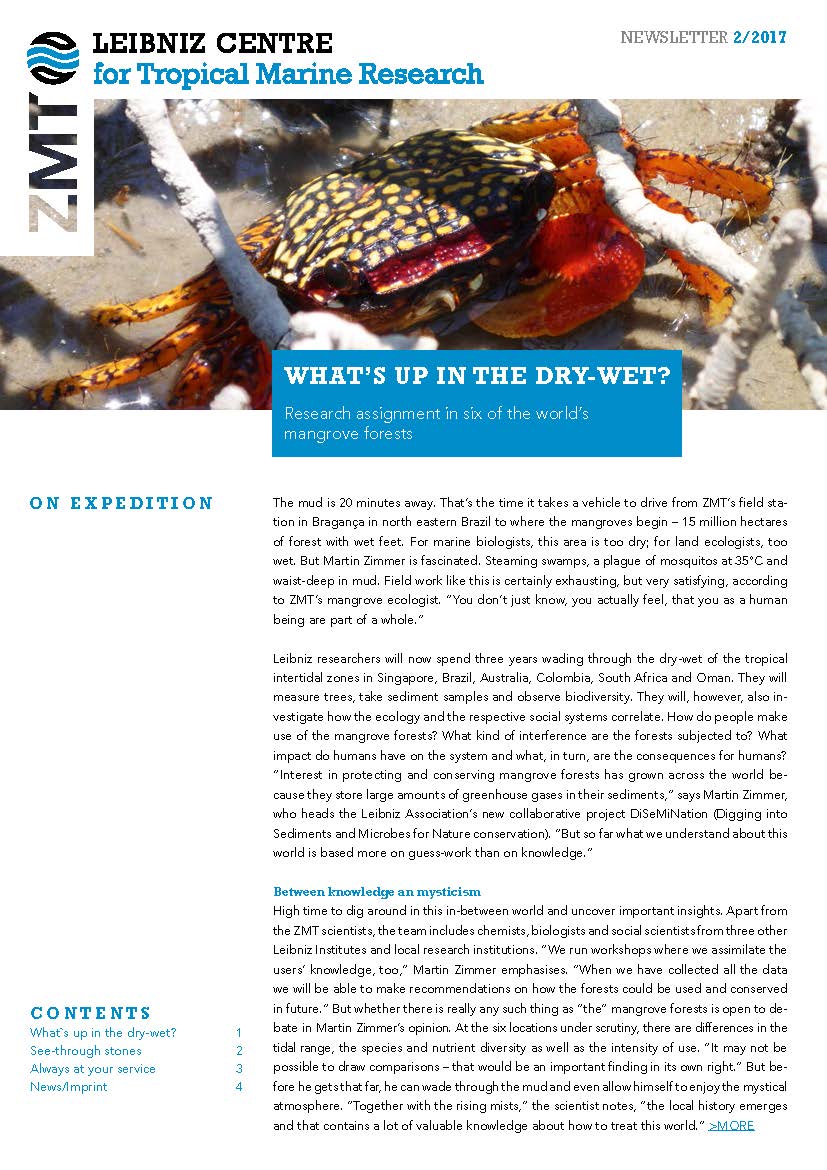
What`s up in the Dry-Wet?
Research assignment in six of the world’s mangrove forests
The mud is 20 minutes away. That’s the time it takes a vehicle to drive from ZMT’s field sta-
tion in Bragança in north eastern Brazil to where the mangroves begin – 15 million hectares
of forest with wet feet. For marine biologists, this area is too dry; for land ecologists, too
wet. But Martin Zimmer is fascinated. Steaming swamps, a plague of mosquitos at 35°C and
waist-deep in mud. Field work like this is certainly exhausting, but very satisfying, according
to ZMT’s mangrove ecologist. “You don’t just know, you actually feel, that you as a human
being are part of a whole.”
ZMT Newsletter #02/2017
The Next Generation
Trained in Zanzibar by ZMT, young researchers head for an optimistic future
When the sun goes down over the sea off Stone Town and a cool evening breeze wafts
through the narrow lanes of Zanzibar City, groups of young people meet in the little snack
bars and share their experiences of the day: scientists from all over the world returning from
diving in the reefs and seagrass beds, from working with local fishermen and from field work
in the villages. None of them share the same background: different countries, different sub-
jects, but they all know about each other and work hand in hand for a new epoch.
ZMT Newsletter #01/2017
The Next Generation
Trained in Zanzibar by ZMT, young researchers head for an optimistic future
When the sun goes down over the sea off Stone Town and a cool evening breeze wafts
through the narrow lanes of Zanzibar City, groups of young people meet in the little snack
bars and share their experiences of the day: scientists from all over the world returning from
diving in the reefs and seagrass beds, from working with local fishermen and from field work
in the villages. None of them share the same background: different countries, different sub-
jects, but they all know about each other and work hand in hand for a new epoch.
ZMT Newsletter #01/2017 (German)
Universe in Microsocm
ZMT researchers collect tiny organisms – their miniscule cosmos
can reveal how the submarine world will respond to climate change.
Brilliant white sand – when ecstatic holidaymakers stroll along Thailand’s beaches
they do not realise that they are walking on the sensational legacies of a world-builder.
“The sand on tropical beaches around the world is largely composed of the calcified
skeletons of foraminifera – single-cell organisms only about six millimetres long,”
says Claire Reymond of ZMT. “You find these protozoa all over the world and
although there are regional differences, they play a significant role in building reefs
and coastal sediments.”
ZMT Newsletter #02/2016
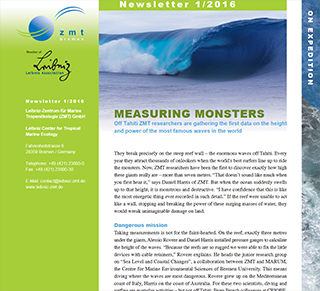
Measuring Monsters
Off Tahiti ZMT researchers are gathering the first data on the height
and power of the most famous waves in the world
They break precisely on the steep reef wall – the enormous waves off Tahiti. Every
year they attract thousands of onlookers when the world's best surfers line up to ride
the monsters. Now, ZMT researchers have been the first to discover exactly how high
these giants really are – more than seven metres. “That doesn’t sound like much when
you first hear it,” says Daniel Harris of ZMT. But when the ocean suddenly swells
up to that height, it is monstrous and destructive.
ZMT Newsletter #01/2016
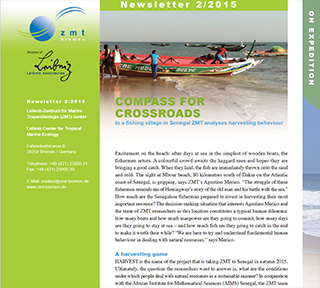
Compass for Crossroads
In a fishing village in Senegal ZMT analyses harvesting behaviour
Excitement on the beach: after days at sea in the simplest of wooden boats, the
fishermen return. A colourful crowd awaits the haggard men and hopes they are
bringing a good catch. When they land, the fish are immediately thrown onto the sand
and sold. The sight at Mbour beach, 80 kilometres south of Dakar on the Atlantic
coast of Senegal, is gripping, says ZMT’s Agostino Merico. “The struggle of these
fishermen reminds me of Hemingway’s story of the old man and his battle with the sea.”
How much are the Senegalese fisherman prepared to invest in harvesting their most
important resource?
ZMT Newsletter #02/2015
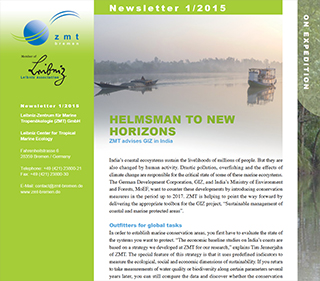
Helmsman to new horizons
ZMT advises GIZ in India
India’s coastal ecosystems sustain the livelihoods of millions of people. But they are
also changed by human activity. Drastic pollution, overfishing and the effects of
climate change are responsible for the critical state of some of these marine ecosystems.
The German Development Corporation, GIZ, and India’s Ministry of Environment
and Forests, MoEF, want to counter these developments by introducing conservation
measures in the period up to 2017. ZMT is helping to point the way forward by
delivering the appropriate toolbox for the GIZ project, “Sustainable management of
coastal and marine protected areas”.
ZMT Newsletter #01/2015
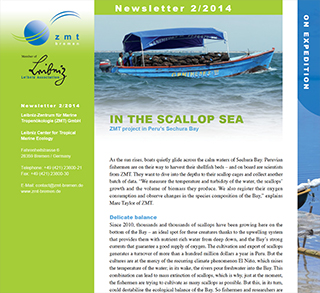
In the Scallop Sea
ZMT project in Peru’s Sechura Bay
As the sun rises, boats quietly glide across the calm waters of Sechura Bay. Peruvian
fishermen are on their way to harvest their shellfish beds – and on board are scientists
from ZMT. They want to dive into the depths to their scallop cages and collect another
batch of data. “We measure the temperature and turbidity of the water, the scallops’
growth and the volume of biomass they produce. We also register their oxygen
consumption and observe changes in the species composition of the Bay,” explains
Marc Taylor of ZMT.
ZMT Newsletter #02/2014
In the Scallop Sea
ZMT project in Peru’s Sechura Bay
As the sun rises, boats quietly glide across the calm waters of Sechura Bay. Peruvian
fishermen are on their way to harvest their shellfish beds – and on board are scientists
from ZMT. They want to dive into the depths to their scallop cages and collect another
batch of data. “We measure the temperature and turbidity of the water, the scallops’
growth and the volume of biomass they produce. We also register their oxygen
consumption and observe changes in the species composition of the Bay,” explains
Marc Taylor of ZMT.
ZMT Newsletter #01/2014
A new departure with Africa
Interdisciplinary research in Zanzibar
Zanzibar – the name evokes images of sun-baked beaches under tropical palms. The
stream of tourists visiting the East African island off the coast of Tanzania is increasing
continually. Giant hotels are being built, one next to the other. “Zanzibar is one of the
fastest growing tourist regions in the Indian Ocean,” says Hauke Reuter of ZMT. And
this is a development that is not exclusively positive. “Coastal resources are used
intensively by the people.” Changes in the marine ecosystems are the result. ZMT has
now started to address important interdisciplinary research issues in this region –
together with local partners.
ZMT Newsletter #02/2013
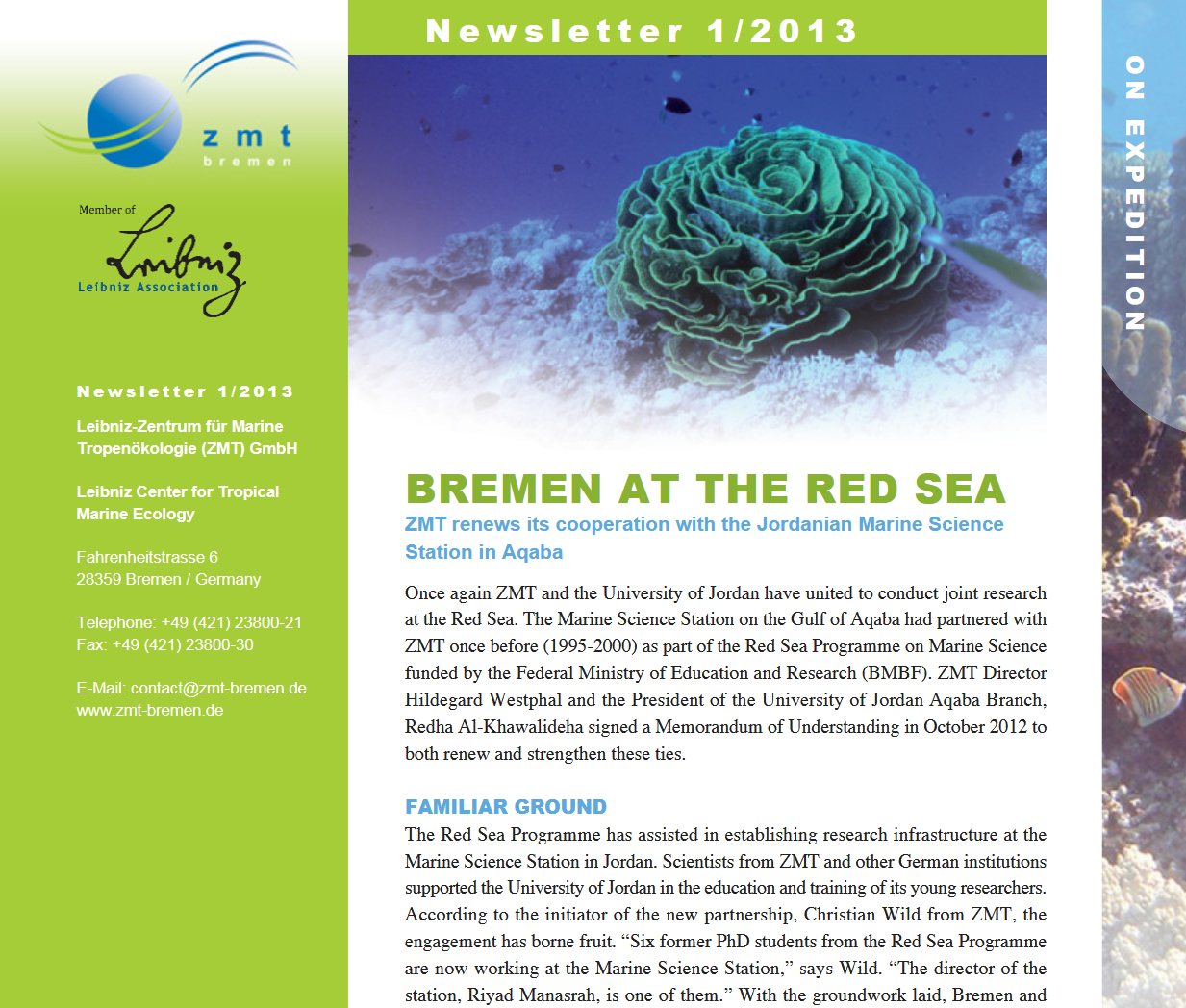
Bremen at the Red Sea
ZMT renews its cooperation with the Jordanian Marine Science
Station in Aqaba
Once again ZMT and the University of Jordan have united to conduct joint research
at the Red Sea. The Marine Science Station on the Gulf of Aqaba had partnered with
ZMT once before (1995-2000) as part of the Red Sea Programme on Marine Science
funded by the Federal Ministry of Education and Research (BMBF). ZMT Director
Hildegard Westphal and the President of the University of Jordan Aqaba Branch,
Redha Al-Khawalideha signed a Memorandum of Understanding in October 2012 to
both renew and strengthen these ties
ZMT Newsletter #01/2013
Bubbling Sensation
ZMT pilot project off Costa Rica made astounding discovery
The “bubbling reef” in the Golfo Dulce was the last stop on the expedition. Here, in
the southernmost part of Costa Rica, local colleagues had discovered gas bubbles
rising from a coral community. Whatever was it? This was a question ZMT biochemist
Tim Rixen, modeller Agostino Merico and reef ecologist Christian Wild were
determined to answer.
ZMT Newsletter #02/2012
Bubbling Sensation
ZMT pilot project off Costa Rica made astounding discovery
The “bubbling reef” in the Golfo Dulce was the last stop on the expedition. Here, in
the southernmost part of Costa Rica, local colleagues had discovered gas bubbles
rising from a coral community. Whatever was it? This was a question ZMT biochemist
Tim Rixen, modeller Agostino Merico and reef ecologist Christian Wild were
determined to answer.
ZMT Newsletter #01/2012