



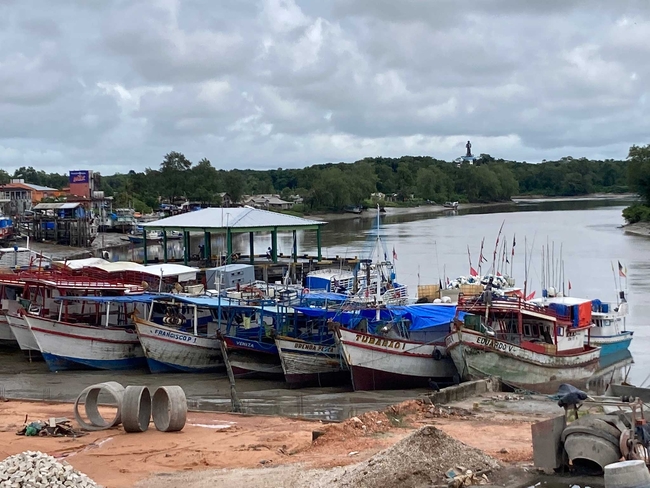
18/12/2025 | Lol Dahlet’s study examines the governance of the pargo (Lutjanus purpureus) fishery – a large‑scale artisanal and export‑oriented fishery based around Bragança, Pará, in northern Brazil – and specifically how artisanal fishers’ participation (or lack thereof) in formal decision‑making processes affects outcomes for equity and sustainability. The social scientist from the working group Social-ecological Systems Analysis received her doctorate at ZMT and the University of Bremen in 2025.
What was the initial question of the study?
In this study, I wanted to find out how the lack of participation of artisanal fishers in formal decision-making influences management outcomes in a large-scale artisanal fishery operating off the coast of North Brazil. The pargo (Lutjanus purpureus) fishery landing in the state of Pará was a particularly good case study. It is a highly regulated fishery in comparison to other fisheries landing in the region, yet research shows that the stock is currently overfished. The fishery is also influenced by international markets, with estimates showing that 70 to 75 percent of its production is exported to the United States. However, fishers (who usually work with a crew of 9 onboard fishing vessels) are not represented within the main management committee (Comitê Permanente de Gestão da Pesca e do Uso Sustentável dos Recursos Pesqueiros Demersais das Regiões Norte e Nordeste, or Permanent Management Committee for Fishing and Sustainable Use of Fish Resources of the North and Northeast Regions).
What was the procedure for the study? What exactly did you investigate?
To investigate this, I analyzed and compared the perceptions of actors formally involved in decision-making (public authorities, civil society organizations and academia) with those de facto excluded from decision-making (fishers). I conducted a total of 18 semi-structured interviews, among which three were participatory network mapping. I also undertook participant observation in pargo landing sites in the municipality of Bragança, which is the most important pargo producer; as well as in two meetings of the main management committee.
What are the new findings?
I came up with three main narratives surrounding the state of the pargo fishery and the main management priorities. A first stream of narrative, which I called “Unity in crisis: declining fish stocks, a challenge for all”, encompassed the perceptions of public authorities, civil society organizations and members of academia, all with a voice in the main management committee. According to these interviewees, the pargo population was under an imminent threat of exceeding the biological limits. The health of the fish stock was presented as the central concern for management, as an absence of fish would mean the end of the fishery for all. Yet, the focus on ecological sustainability was also used as a politically neutral terrain to bypass more thorny debates such as the operation of unregulated vessels in the fishery.
A second stream of narrative emerged, which I called “Declining catch shares, not biomass: negotiating open access” shared by representatives and interviewees belonging to the fishing industry, vessel owners and academia. The pargo fishery was primarily depicted in terms of its production levels, with the fishery being depicted as generally in good condition. The key threat to the fishery’s sustainability was the overcapacity in terms of the number of vessels operating.
A third stream of narrative titled “Silenced scarcities: scarcity for some, abundance for others” included the perception of all fishers interviewees and a representative of public authorities. While the respondents in this narrative reported it was getting harder and harder to catch pargo, poor labor rights, lack of access to social protections and food insecurity were the central concern for fishers. In their interviews, fishers also reveal how international market requirements directly influence on local fishing practices. For instance, the pay of fishers depends on the international export value of the fish they capture, the most valuable specimens on the international market being typically around 30 cm long, weighing between 600 grams and 1 kilogram, and bright red.
What conclusions can be drawn from this?
The results indicate that different actors identify, formulate, and construct problems related to resource use and resource scarcity in different ways. These discursive constructs are neither politically neutral nor hermetic in relation to one another or the wider governance structures and processes. Each narrative shows that the way fishery-related problems and challenges are depicted influences the type of solution devised, who benefits, and who is excluded.
The management committee mainly reflects the first two narratives, excluding fishers’ knowledge and key social equity concerns. Thus, the knowledge and experience of fishers regarding the causes of overfishing and the urgent challenges related to decent labor, social protections, and food security, remain unaddressed. Global market pressures disproportionately burden fishers, as rigid international market requirements clash with local social and ecological realities.
Thus, the study recommends ensuring the representation of fishers and balanced participation in the formal management of the pargo fishery. The management committee should organize its meetings in a way that accommodates the availability of fishers’ representatives in terms of dates, times, and modalities. The study also recommends establishing an advisory structure linked to the management committee that includes artisanal fishers' representatives. This structure would develop indicators, methods, and evaluation approaches that promote social equity in the pargo fishery and its governance processes.
What could be the effects on the ecosystem, humans, animals, etc.?
The effects of the current governance approach and exploitation patterns in the pargo fishery in northern Brazil extend beyond the health of the fish stock, and impacts fishers livelihoods and the coastal and marine ecosystem. Declining catches, poor labor conditions, and limited access to social protections create economic and food insecurity for fishers, making them more vulnerable to environmental and market fluctuations. The pressure to meet export standards encourages practices that jeopardize ecological sustainability, such as harvesting fish before they reach reproductive maturity. Along with the increasing impacts of climate change, these dynamics represent an extra burden on fishworkers, who are at the forefront of ecological and social-economic vulnerabilities.
This illustrates the need for a paradigm shift in fisheries management. Achieving sustainable fisheries requires recognizing that ecological and economic sustainability are closely tied to social equity and embracing more decisively this understanding in formal fisheries governance.
Why should the general public be interested in these results?
In an increasingly globalized world, it is not uncommon for fish to travel around the world before ending up on consumers’ plates. Behind this source of protein, there are complex processes and struggles over access to fishing resources and their benefits, which may or may not lead to overt conflicts. Fishworkers often bear the brunt of the costs associated with inequitable fisheries and governance, while capital-intensive fishing and processing companies reap the benefits. Understanding these dynamics allows us to connect everyday consumer food options with broader issues of social justice, decent livelihoods, and ecological sustainability; and to interrogate how more sustainable alternatives could potentially be achieved.
The world's attention was on Belém, Brazil's symbolic capital just over amonth ago, as it hosted the UN Climate Change Conference COP30 from November 10 to 21, 2025. With oil exploration prospects coinciding with pargo fishing grounds off the Amazon estuary, it is urgent that the voices of those whose livelihoods depend most directly on these coastal and marine ecosystems be amplified.
Publication:
Dahlet, Lol. 2025. Equitable participation as a key mechanism towards sustainable fisheries management: a case study of the pargo (Lutjanus purpureus) fishery governance in northern Brazil. Ocean & Coastal Management 270: 107914. https://doi.org/10.1016/j.ocecoaman.2025.107914
References:
Aragão, J.A. (2018) Plano de Recuperação do Pargo (Lutjanus purpureus), Ministério do Meio Ambiente, Brasília, 51 pp.
Bennett, N.J., Katz, L., Yadao-Evans, W., Ahmadia, G.N., Atkinson, S., Ban, N.C., Dawson, N.M., de Vos, A., Fitzpatrick, J., Gill, D., Imirizaldu, M., Lewis, N., Mangubhai, S., Meth, L., Muhl, E.-K., Obura, D., Spalding, A.K., Villagomez, A., Wagner, D., White, A., Wilhelm, A., 2021. Advancing social equity in and through marine conservation. Front. Mar. Sci. 8, 711538. https://doi.org/10.3389/ fmars.2021.711538.
Bennett, N.J., Relano, V., Roumbedakis, K., Blythe, J., Andrachuk, M., Claudet, J., Dawson, N., Gill, D., Lazzari, N., Mahajan, S.L., Muhl, E.-K., Riechers, M., Strand, M., Villasante, S., 2025. Ocean equity: from assessment to action to improve social equity in ocean governance. Front. Mar. Sci. 12. https://doi.org/10.3389/ fmars.2025.1473382.
da Costa Pinheiro, L., Ferreira, B.P., Santos, P.E., Peixoto, U. and Bentes, B. (2024) ‘Recent findings on spawning patterns and recommendations for the fishery management of the southern red snapper—Lutjanus purpureus (Poey, 1866)—on the Amazon continental shelf of Brazil’, Fishes, 9(4):136. https://doi.org/10.3390/fishes9040136.
Dias, M., de Oliveira, S., Faria, G. and Canton, L. (2023) ‘Subsídios para a implantação de limites de captura para a pesca do pargo (Lutjanus purpureus): análise da cadeia produtiva e da viabilidade do controle por meio do volume de exportação’. Oceana Brasil, Brasília. Available at: https://www.examplelink.com (Accessed: March 2025)
Roberts, C., Bené, C., Bennett, N., Boon, J.S., Cheung, W.W.L., Cury, P., Defeo, O., De Jong Cleyndert, G., Froese, R., Gascuel, D., Golden, C.D., Hawkins, J., Hobday, A.J., Jacquet, J., Kemp, P., Lam, M.E., Le Manach, F., Meeuwig, J.J., Micheli, F., Morato, T., Norris, C., Nouvian, C., Pauly, D., Pikitch, E., O’Leary, B.C., 2024. Rethinking sustainability of marine fisheries for a fast-changing planet. npj Ocean Sustain. 3, 41. https://doi.org/10.1038/s44183-024-00078-2.
 Contacts
  Programme Areas
  Working Groups