

The Hydro-Geochemical Fluxes Working Group investigates how tropical landscapes, hydrological and hydrogeological systems, and human activities interact to control material fluxes across terrestrial and coastal environments. We are particularly interested in how water pathways and hydrogeochemical processes regulate the transport, transformation, and fate of dissolved substances. By integrating process-based modelling with field observations and laboratory experiments, we investigate these processes across spatial and temporal scales and under natural variability and human-induced change.
Source-to-Sea Fluxes
We investigate how surface-water and groundwater pathways connect terrestrial environments to the sea and regulate the transport and transformation of solutes along the land–ocean continuum. A particular focus is on understanding where solutes originate, how water flow controls their movement, and how hydrogeochemical and biogeochemical processes modify them along the way. We also examine how seasonality, extreme hydrological events, land-use change, and other human pressures alter these pathways and associated fluxes. Current research focuses on carbon and nutrient transport and transformation in tropical catchment-to-coast systems.
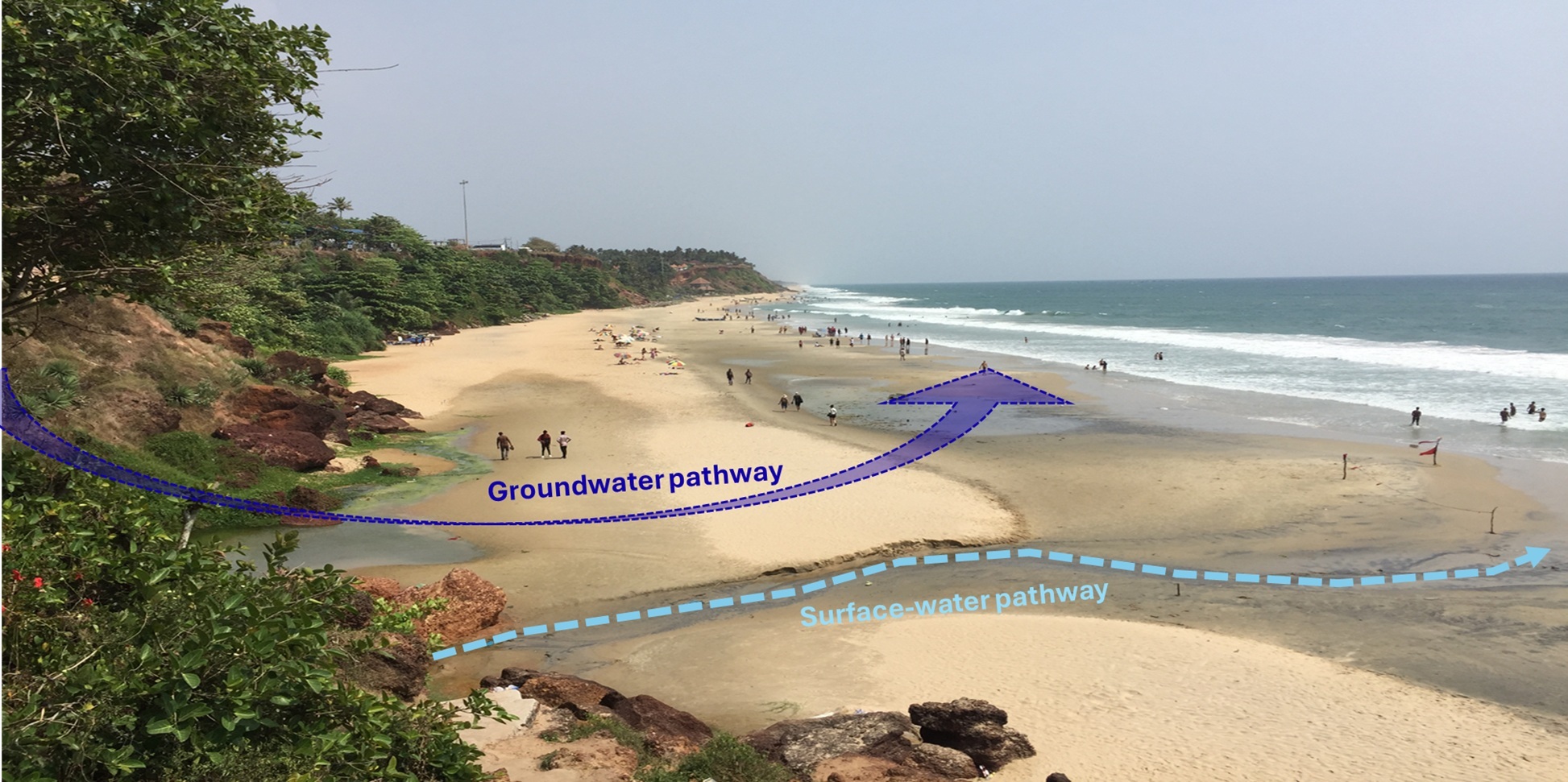
Conceptual illustration of surface-water and groundwater pathways connecting terrestrial environments with the coastal ocean.
Contaminant Fate and Remediation
Mine tailings, waste-rock deposits, landfills, and other waste sites can release contaminants through leaching, potentially affecting groundwater and connected surface waters over long timescales. We investigate how groundwater flow, geological heterogeneity, and hydrogeochemical reactions control contaminant transport, distribution, transformation, attenuation, and long-term fate. A particular focus is on understanding how contaminant plumes develop and evolve, how impacts persist over time, and how process understanding can support the assessment of natural attenuation and remediation strategies. Current research focuses on contaminant transport and long-term hydrogeochemical impacts associated with mine tailings and waste-rock deposits.
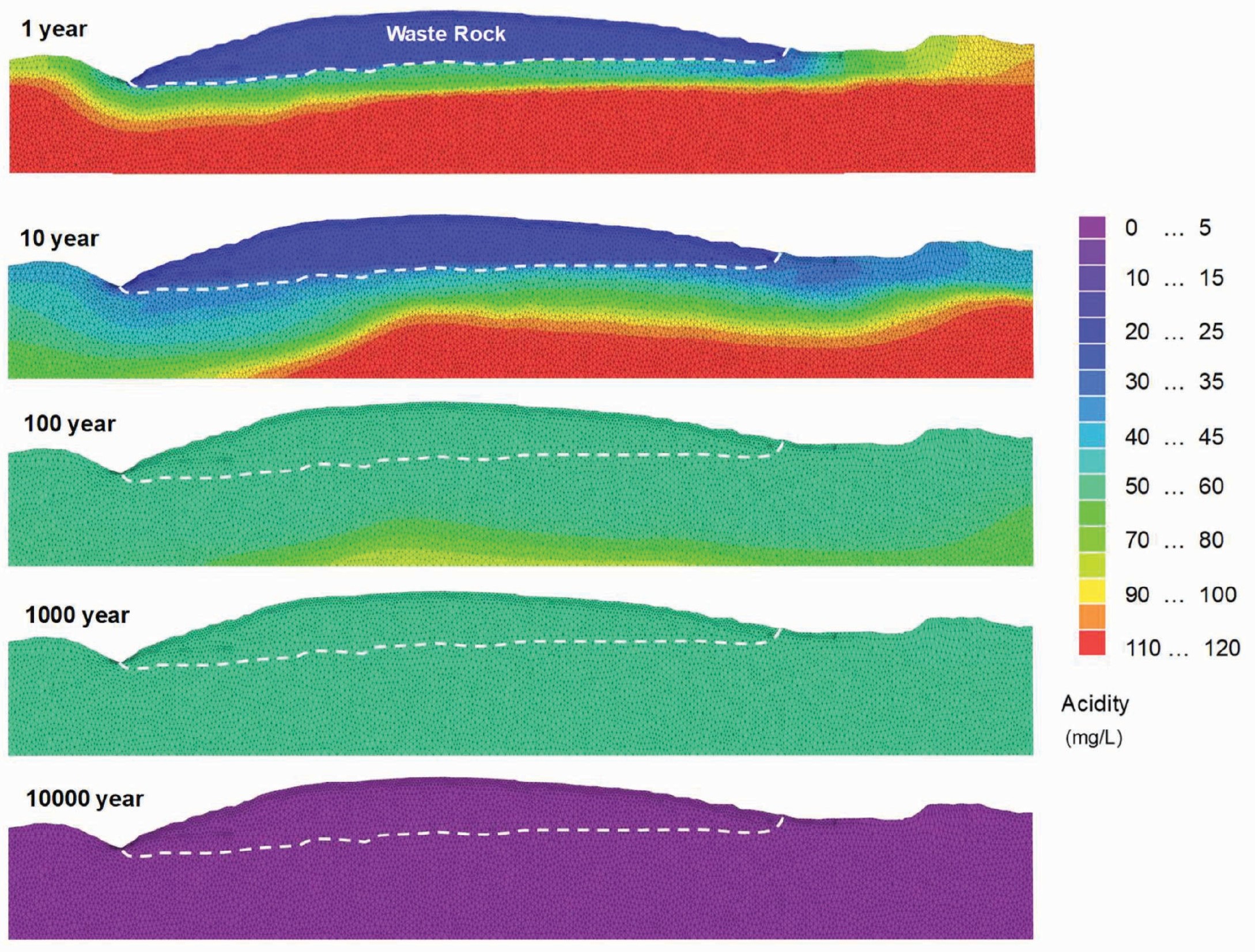
Simulated changes in groundwater acidity over time beneath a coal-mine waste-rock pile.
Join Us and Collaborate
We welcome collaborations and enquiries from Master’s students, doctoral researchers, postdoctoral researchers, and visiting scientists interested in hydrogeology, hydrogeochemistry, environmental geochemistry, and process-based modelling. Depending on the research question, projects can combine numerical modelling with targeted field observations, laboratory experiments, and data analysis. If you are interested in developing a related research idea or exploring a potential collaboration, please get in touch.
 WG Members