

22/05/2026 | The annual conference of the European Cetacean Society (ECS) is one of the leading international meetings for researchers and practitioners working on whales, dolphins and porpoises. Bringing together experts from ecology, conservation, technology, management and social sciences, the conference provides an important platform for interdisciplinary exchange. This year’s conference took place in Dundee, Scotland, and welcomed around 800 participants from across Europe and beyond. For Wiebke Homes from the Leibniz Centre for Tropical Marine Research (ZMT) it was already the third ECS participation - and according to her “one of the most useful conferences attended so far.”
Citizen science for marine education and conservation
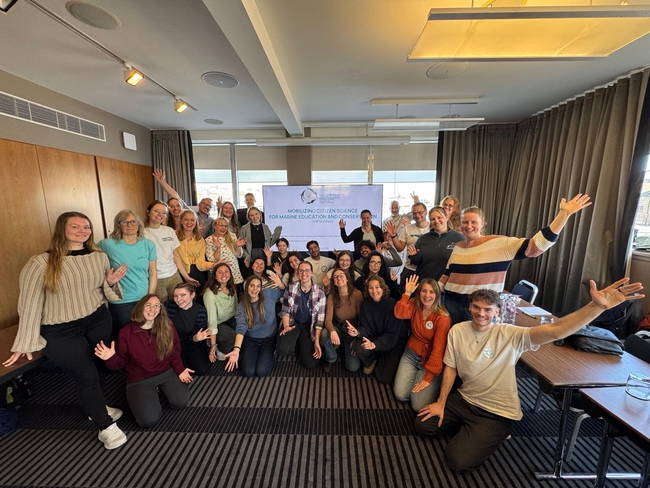
The first two days of ECS 2026 are dedicated to workshops. Together with Eleonora Barbaccia from the at the Politecnico di Milano, Wiebke Homes organised and hosted the workshop “Mobilizing citizen science for marine education and conservation”. The workshop explored how citizen science can support marine mammal monitoring, education and conservation efforts.
More than 30 participants joined the workshop, representing NGOs, universities, research institutions and most importantly a wide range of citizen science initiatives. Participants presented ongoing projects and discussed practical challenges and opportunities related to data quality and validation, participant engagement, ethics and inclusivity and pathways from citizen-generated data to actual conservation impact.
The workshop highlighted the growing importance of interdisciplinary collaboration and public participation in marine conservation. Discussions particularly focused on how to best train citizen scientists, how to ensure their long-term engagement, how generated data can be standardized across projects to as well as how citizen science approaches could contribute more directly to policy implementation. Beyond networking and exchange, the break-out groups generated many practical ideas on improving citizen science methodologies and strengthened future collaborations, including transnational monitoring efforts and shared outreach materials.
The themes of the workshop closely connect to ongoing work within the project, which is currently piloting the outreach initiative “Biodiversität im Blick - Meeresforschung live erleben” on Sylt (in collaboration with the Schutzstation Wattenmeer). During these interactive research excursions, participants become part of a hands-on real marine research team consisting of Wiebke and CREATE-colleagues. They experience methods such as environmental DNA (eDNA) sampling, plankton monitoring and underwater acoustic recordings firsthand. By combining innovative marine research methods with public involvement, the initiative aims to foster ocean literacy while generating societal interest in biodiversity monitoring and marine conservation.
Emerging: eDNA as methodology for transdisciplinarity and co-design in marine mammal research
In addition to organizing the citizen science workshop, Wiebke Homes also attended a full-day workshop on eDNA highlighting the rapid progress being made in this emerging research field and a strong and growing interest in integrating eDNA-based methods into future pan-European marine mammal monitoring projects.
The main conference programme covered a broad spectrum of topics related to cetacean ecology, conservation and management, including anthropogenic impacts, passive acoustic monitoring, animal behaviour, habitat and distribution, conservation policy and emerging technologies. Wiebke Homes also presented a poster on the ongoing marine education work in the CREATE-project, highlighting the role of transdisciplinary approaches and co-design processes in bringing together researchers, practitioners and communities to co-create knowledge and conservation solutions. The resulting discussions centred on how marine education can contribute to ocean literacy, foster stewardship and strengthen the connection between public engagement, social science and effective (marine mammal) conservation practice. These exchanges generated new ideas for future interdisciplinary collaborations, not only within Germany but also across seas.
Beyond the scientific programme, the atmosphere throughout the conference was exceptionally open, welcoming and motivating. Numerous social events including movie and dance nights as well as a boat trip on the Tay Estuary created opportunities for informal exchange between senior and early-career researchers. Although no dolphins or whales were spotted during the excursion, participants were rewarded with sightings of playful seals and unusually sunny Scottish weather. The conference provided many valuable takeaways and contacts and fresh inspiration, particularly regarding the integration of social science perspectives into a field that remains strongly dominated by natural sciences. Discussions initiated in Dundee are expected to continue at next year’s ECS conference in Piran, Slovenia.