



The Dynamic Deep Subsurface
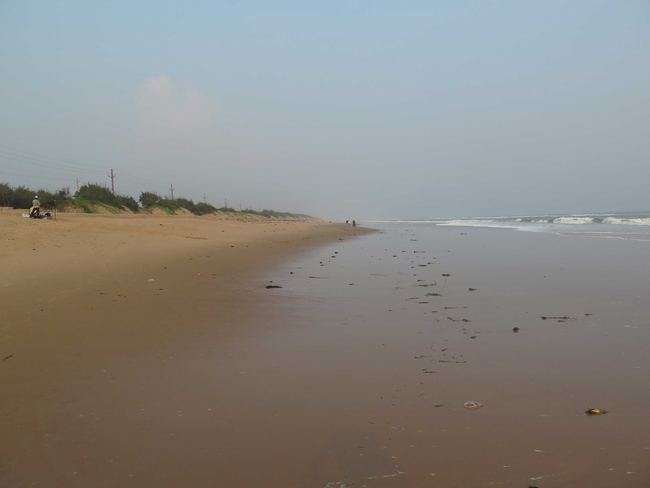
Along the world’s coastlines, groundwater flows from land to sea. Beneath sandy beaches, fresh and seawater mix in underground zones called Subterranean Estuaries (STEs). These systems act as natural biogeochemical reactors, regulating how carbon, nutrients, and trace elements enter the ocean. In beaches exposed to high energy from strong waves and tides, these processes are especially dynamic. Such high-energy STEs remain poorly represented in coastal and Earth system models.
Connecting Local Insights to Global Patterns
The DFG Research Group DynaDeep, led by Gudrun Massmann (University of Oldenburg), investigates the physical, biogeochemical, and microbial processes shaping these subsurface systems. Our subprojects’ (P7) focus is on extending this work from local field sites to the global scale, revealing how STEs regulate water and solute fluxes.
Objectives and Challenges
We will quantify freshwater and saltwater flow through sandy STEs worldwide, determine how long water and solutes remain in these systems, and assess how climate change may alter these fluxes. Key challenges include resolving STEs’ complex internal structure, capturing the variability of energetic beaches, and scaling detailed local models to a global perspective.
Methodology and Approach
The project combines global data synthesis, numerical modeling, and machine learning. A global beach attribute database, intertidal morphology, permeability, and aquifer depth - represents the diversity of beaches along the global coasts. These data inform numerical simulations of STEs, resolving groundwater flow, salt mixing, and residence times, which train surrogate models that efficiently predict STE behavior across the global coastline.
Expected Outcomes
The project will produce global maps of present-day and future freshwater and saltwater fluxes through sandy STEs. These outputs provide the foundation for estimating nutrient and element inputs to the ocean and for understanding how climate change may reshape these hidden coastal reactors by 2100.
 Contacts
 Programme Areas
 Working Groups
 Project flyer for download