


How extreme is today’s ocean warming? Fossil corals from the Red Sea could offer new insights
Marine heatwaves and coral bleaching events are increasing worldwide as ocean temperatures rise. A new research project at the Leibniz Centre for Tropical Marine Research (ZMT) is now looking deep into Earth’s past to better understand how unusual today’s warming is. The three-year project is funded by the German Research Council (DFG) with 450,000 Euro.
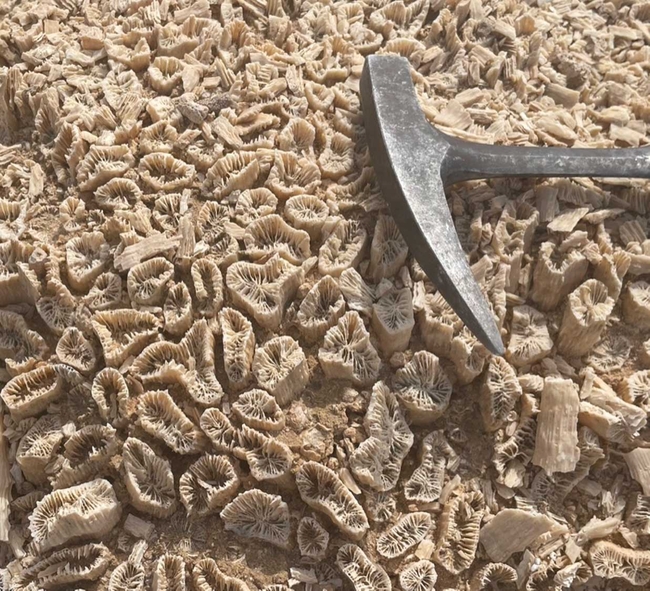
In the framework of the PALEORED project scientists will study exceptionally well-preserved fossil corals from the Red Sea that grew during the Last Interglacial period around 125,000 years ago. At that time, global temperatures were about 1 to 2 °C warmer than pre-industrial levels and the global sea level was several meters higher than today.
“The Last Interglacial is the closest natural benchmark we have for a warmer world,” explains Dr. Sara Todorović, postdoctoral researcher at ZMT and principal investigator of the project. “It allows us to compare modern climate change with a period when Earth was naturally warm, but without human influence.”
Fossil corals as climate archives
Corals grow continuously and record information about their environment directly in their skeletons, much like tree rings on land. This makes them unique natural archives of past ocean conditions. By analysing the chemical composition and growth patterns of fossil corals, researchers can reconstruct past sea surface temperatures, seasonal variability, seawater chemistry, and potential heat-stress events at monthly to annual resolution.
“Such detail is impressive for an era so distant in Earth’s geological past,” says Todorović. “It means we can identify not only average conditions, but also short-lived extremes such as marine heatwaves and compare them with conditions which are particularly damaging to coral reefs today.”
The Red Sea plays a key role in this research. It is one of the warmest and saltiest marine regions worldwide, and its corals are known for their unusually high tolerance to heat. “Red Sea corals live close to their thermal limits even today,” Todorović explains. “Understanding how they responded to prolonged warmth and temperature extremes in the past helps us assess how resilient coral reefs can be under ongoing global warming. This can be very helpful in management and restoration efforts.”
Part of a broader climate research effort
The PALEORED project is embedded in the German Research Foundation’s Priority Programme SPP 2299 – “Tropical Climate Variability & Coral Reefs”, which focuses on tropical climate variability and its interaction with global climate change. By providing high-resolution observational data from a past warm period, the project addresses a major gap in existing climate records and supports the evaluation of current climate model simulations.
“What makes today’s climate change unique is not only how warm it is, but how fast it is happening,” says Todorović. “By comparing past and present, we can better understand whether current warming is pushing coral reef ecosystems beyond conditions they have experienced before.”
The three-year project is funded by the DFG and is carried out at ZMT within the Geoecology and Carbonate Sedimentology working group (PA4), and in close collaboration with national and international partners (Consiglio Nazionale delle Ricerche (CNR), Bologna, Italy). Its results will contribute to a better assessment of the risks that rapidly warming oceans pose to coral reef ecosystems and the services they provide to society.
 Contacts
  Programme Areas
  Working Groups