


10 Years of CAMPUS AWARD: Sustainable Initiatives from the Academic Community
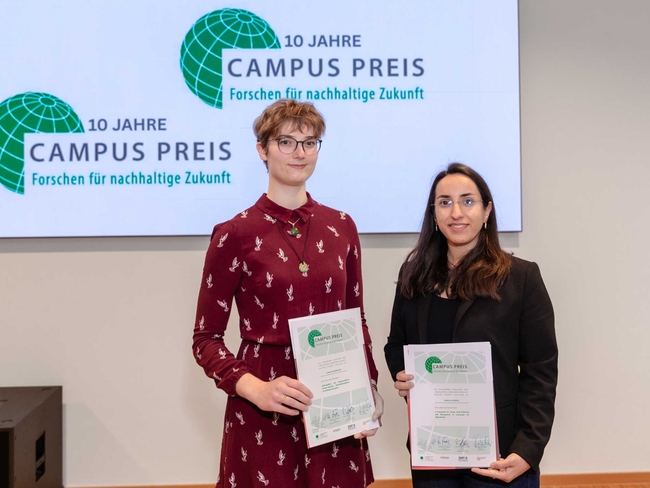
This year, the “CAMPUS AWARD: Research for a Sustainable Future” honors one dissertation and one master’s thesis. Shadi Attarha and Lana Draghinazzi have impressed the jury with their innovative approaches to sustainable solutions for ecological challenges. The award was presented on May 21.
PhD Dissertation: Sustainable Agriculture Through Sensor Precision
In her PhD thesis, Shadi Attarha investigates how faults in smart agriculture sensors can be detected at an early stage to prevent false measurements. Her work makes an important contribution to sustainability, as technical devices can remain in use longer, and farmers receive more reliable information.
Her research focus lies on interconnected sensors within the Internet of Things (IoT), which are increasingly used in modern agriculture. The IoT connects physical devices to the internet, which allows them to exchange data. This technology enables a more efficient use of energy, water, and agricultural inputs such as fertilizers and pesticides and can be particularly beneficial for smallholder farmers.
Because sensors are prone to malfunctions, Attarha develops innovative algorithms that monitor data quality in real time, thereby significantly increasing system reliability. Her solutions are openly accessible and can be used across all platforms. Research partners for this work came from Sri Lanka, Cameroon, and Thailand.
Master’s Thesis: Environmentally Friendly Industrial Lubricants Made from Algae
Lana Draghinazzi’s master’s thesis demonstrates for the first time that algae can be used to produce environmentally friendly hydraulic fluids. In doing so, the graduate of the University of Bremen provides key insights into sustainable technologies and the use of renewable raw materials.
Currently, most hydraulic fluids used in machinery – especially mobile systems that operate in direct contact with the environment – are based on mineral oil and contain toxic additives. Thus, leaks can lead to significant environmental pollution. Alginates, bio-based substances derived from brown algae, offer a promising alternative. They are renewable, environmentally harmless, and – since algae absorb large amounts of CO₂ as they grow – contribute to a favorable carbon footprint.
Draghinazzi’s thesis shows that algae‑based fluids, when combined with suitable environmentally compatible additives, can achieve properties comparable to conventional hydraulic fluids. This paves the way for reducing dependence on fossil resources and significantly reducing environmental risks. The project was carried out in close collaboration with regional industry partners.
The results of the master’s thesis are already being incorporated into industrial development and form the basis for new research projects in the field of eco-friendly hydraulic systems.
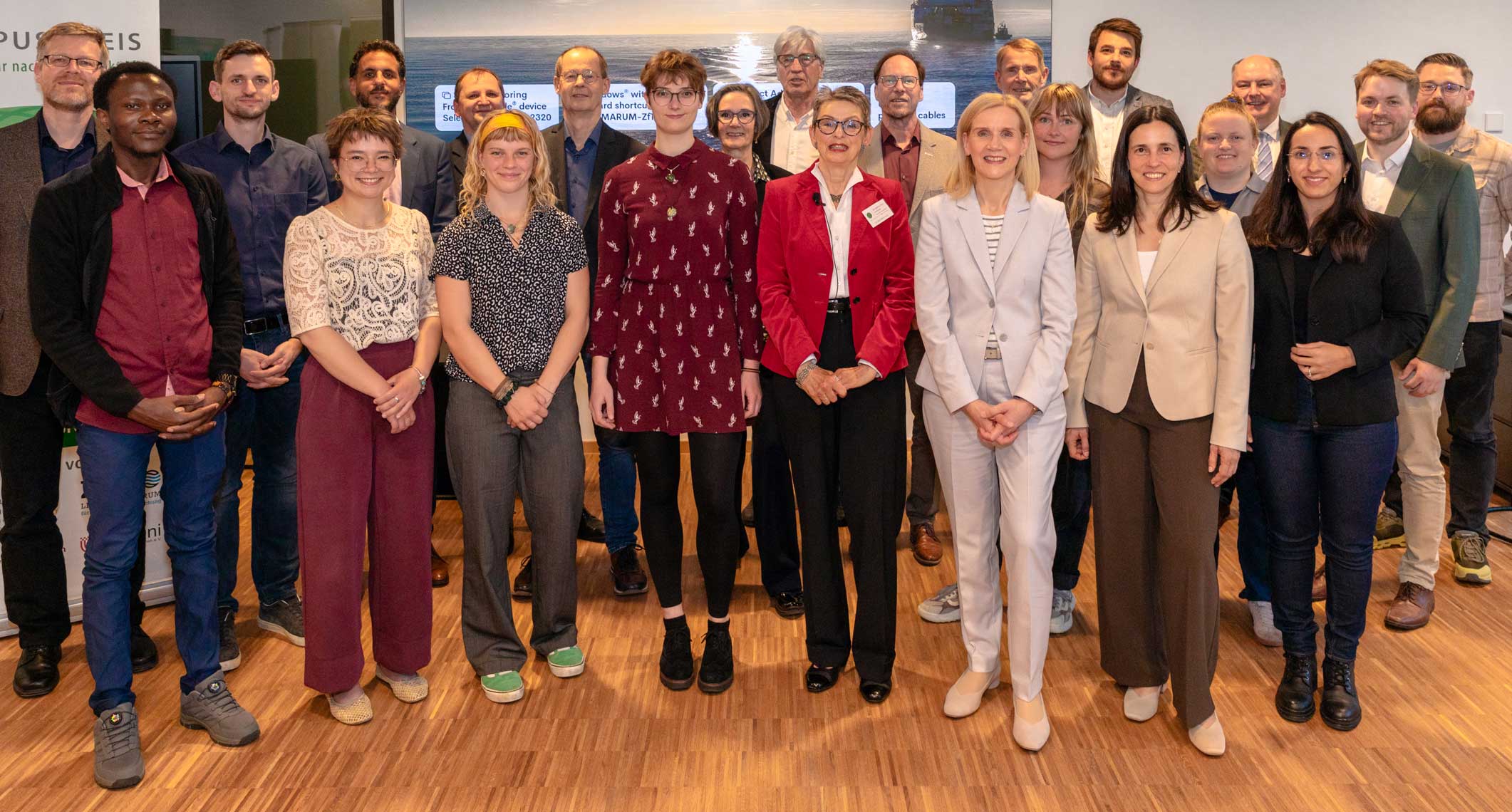
A strong team of nominees, nominators, organisers, presenters, and jury members has contributed to the success of the Campus Prize over the past ten years. | Photo: Matej Meza, University of Bremen
The CAMPUS AWARD: 10 Years of Award-Winning Theses
For the past ten years, the CAMPUS AWARD has been honoring outstanding theses written on the campus of the University of Bremen that are dedicated to the sustainable use of resources, the protection of the environment, the climate, and the oceans. The award was established in 2016 and is presented once a year by the KELLNER & STOLL FOUNDATION FOR CLIMATE AND ENVIRONMENT, the Leibniz Centre for Tropical Marine Research (ZMT), the University of Bremen, and the University of Bremen Alumni Network. It is endowed with a total of 3,000 euros.
 Contacts