

Stronger together: Bremen’s marine, polar and climate research at the German Unity Day public festival in Bremen
Deep sea, coral reefs, polar ice and climate research: At the public festival marking German Unity Day, research institutions from Bremen and Bremerhaven will come together to showcase the wide range of research taking place across the State of Bremen. From 2 to 4 October, they invite visitors to the former Galeria Kaufhof department store in Bremen city centre to explore, marvel and get involved. Around 400,000 visitors from the region and across Germany are expected to attend the main celebrations, which are being hosted by the State of Bremen this year.
The State of Bremen is one of Germany’s leading centres for marine, polar and climate research. At the public festival marking German Unity Day, six institutions and two Collaborative Research Centres will join forces to showcase the research being conducted in these fields across the State of Bremen and demonstrate the close links between the institutes and their various areas of research.
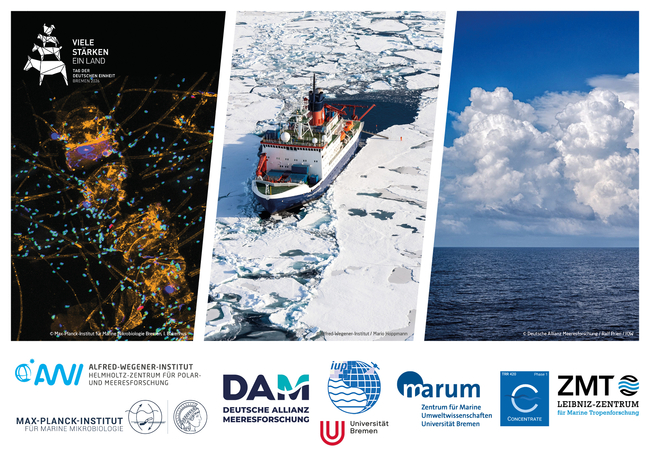
Taking part are the Alfred Wegener Institute, Helmholtz Centre for Polar and Marine Research (AWI), the German Marine Research Alliance (DAM), the Institute of Environmental Physics (IUP) at the University of Bremen, the Leibniz Centre for Tropical Marine Research (ZMT), MARUM – Center for Marine Environmental Sciences at the University of Bremen, and the Max Planck Institute for Marine Microbiology.
Under the motto “Marine, polar and climate research in Bremen – stronger together”, the five institutes and the alliance will present their work in the “BREMENwelt Wissenschaft” science area on the ground floor of the former Galeria Kaufhof building, inviting visitors of all ages to experience science first-hand.
From the deep sea to the atmosphere
What happens at black smokers in the deep sea? How are coral reefs faring in a changing climate? What can polar ice tell us about changes to our planet? And how do scientists study the atmosphere and the global climate system?
At the stands, visitors can explore these and many other questions, immerse themselves in fascinating underwater worlds, discover coral reefs and get a glimpse of the new Polarstern. Virtual reality experiences will take them to Antarctica, the tropics and even towards outer space.
Experiments, games and interactive activities invite visitors to have a go and get involved. Researchers from the participating institutions will offer insights into their work and be on hand to answer questions and talk to visitors. In this way, the diversity of marine, polar and climate research in Bremen and Bremerhaven becomes a hands-on experience.
Working together on research for the future
The oceans, polar regions and atmosphere are key components of the Earth system and are closely interconnected. What happens in these environments affects the climate, ecosystems and people’s living conditions around the world. Understanding the changes taking place and the interactions between them – and generating the knowledge needed to use our seas and oceans sustainably – requires research that reaches across disciplinary and institutional boundaries.
Henrike Müller, Senator for Environment, Climate and Science, says: “This close network is a particular strength of Bremen and Bremerhaven as a centre of research. At the public festival, it will be visible to a wide audience: the participating institutions are bringing their research right into the heart of the city and, together, showing how knowledge about the oceans, climate and environment is generated – and why it matters for our future.”
At a glance
Marine, polar and climate research in Bremen – stronger together
Public festival marking German Unity Day
When:
2 October: 4.00 – 8.00 pm
3 and 4 October: 10.00 am – 8.00 pm
Where: Former Galeria Kaufhof building | Papenstraße 5, Bremen | Ground floor
Participating institutions (in alphabetical order):
Alfred Wegener Institute, Helmholtz Centre for Polar and Marine Research (AWI)
German Marine Research Alliance (DAM)
Institute of Environmental Physics (IUP), University of Bremen
Leibniz Centre for Tropical Marine Research (ZMT)
MARUM – Center for Marine Environmental Sciences, University of Bremen
Max Planck Institute for Marine Microbiology
DFG Collaborative Research Centre TRR 420 CONCENTRATE
DFG Collaborative Research Centre TRR 172 “Arctic Amplification (AC)³”
 Contacts