



Coastal communities worldwide depend on marine ecosystems for food security and livelihoods, while facing accelerating pressures from global change. The newly established Working Group Ecosystems and Resource Sustainability, led by Dr. Stefan Koenigstein, investigates how marine living resources are shaped by environmental and ecosystem conditions, and impacted by fisheries and other anthropogenic pressures.
The group develops and applies a range of quantitative ecological models, using ocean and Earth system model outputs, ecological data and eco-physiological processes, and input from local stakeholders. Our goals are to better understand the dynamics of marine ecosystems and their resilience to exploitation, to anticipate future trends in resources and fisheries under climate change, and to co-develop sustainable, ecosystem-based adaptation strategies together with coastal communities.
Integrative models, based on ecological mechanisms
Process-based ecological models are core tools of the group, including population, multispecies, and food-web models. By incorporating knowledge and data on age structure and life histories, physiological tolerances, spatial migrations and ecosystem interactions, process-based models allow us to explicitly represent the biological and environmental processes that govern marine population and ecosystem dynamics. These models can make use of diverse empirical data sources, can be coupled to high-resolution ocean-biogeochemical and climate models, and enable a transfer of understanding from data-rich systems to data-poor regions such as in the tropics, and a more robust assessment of global change and fisheries impacts.
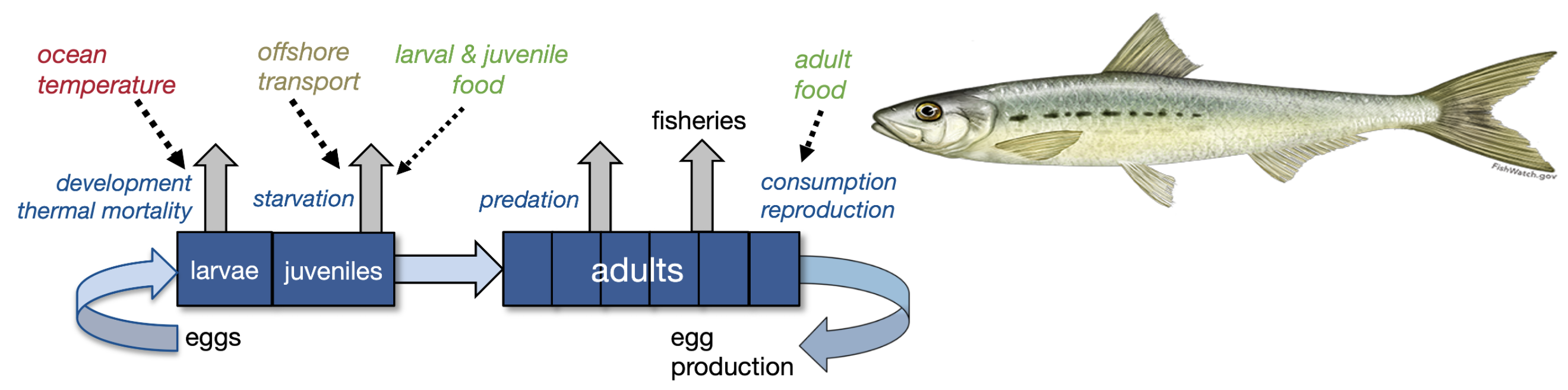
A process-based, full life-cycle model for small pelagic fish populations and their environmental interactions, predators and fisheries in the California Current (Koenigstein et al. 2020, ICES JMS)
Ecosystem-based advice for governance and adaptation
To balance ecological realism with transparency, robustness and applicability, the group employs multi-species ‘Models of Intermediate Complexity for Ecosystem assessment’ (MICE), food-web models and system dynamics models. These models represent the main environmental, ecological, and human components of a marine resource system, and help us to identify ecosystem-based governance and adaptation strategies. Model hindcasts and future projections, ensemble simulations and sensitivity analyses are used to calibrate and assess models, quantify uncertainty, and create future projections of ecosystems and resources under global change, providing relevant information for ocean users, management, and policy.
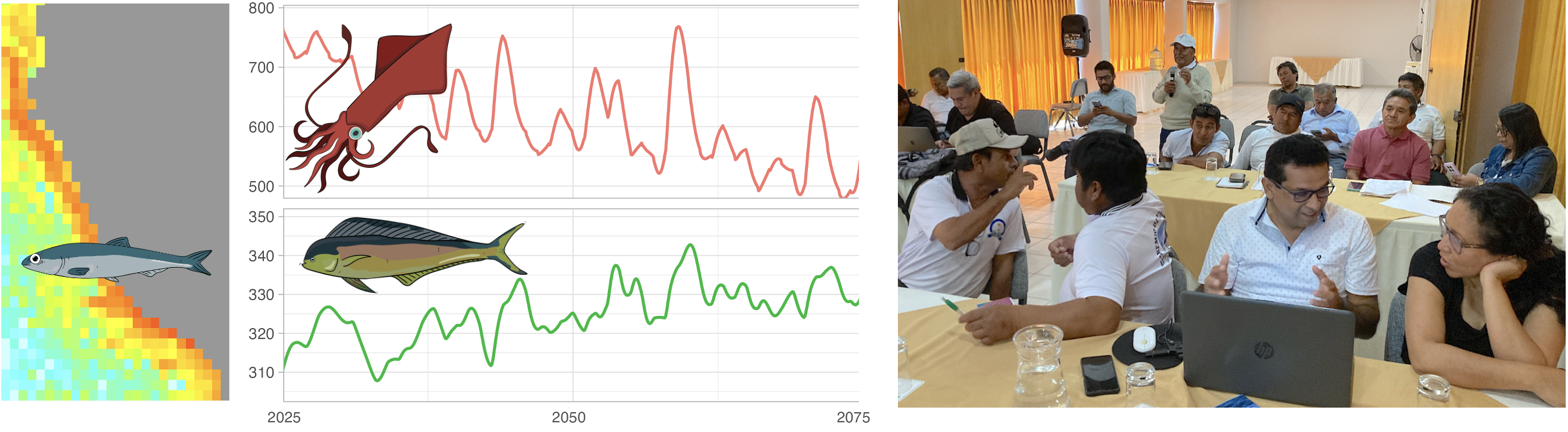
A spatial food-web model for the Peruvian upwelling system projects the future distribution, productivity and biomass of living resources, and is co-assessed together with stakeholders from small-scale fisheries (Koenigstein et al. in prep.)
Participatory modeling and sustainability science
Model development is often participatory, involving stakeholders in co-design of research questions, model structures, and scenarios. This supports the co-production of knowledge, the evaluation of adaptation strategies, and mutual learning between scientists and local actors. Beyond quantitative modeling, the group engages in inter- and transdisciplinary marine sustainability science, e.g. co-developing regionalized global change scenarios and an educational class-room game to support dialogue, negotiation and collaborative learning about sustainable ocean resource use strategies.
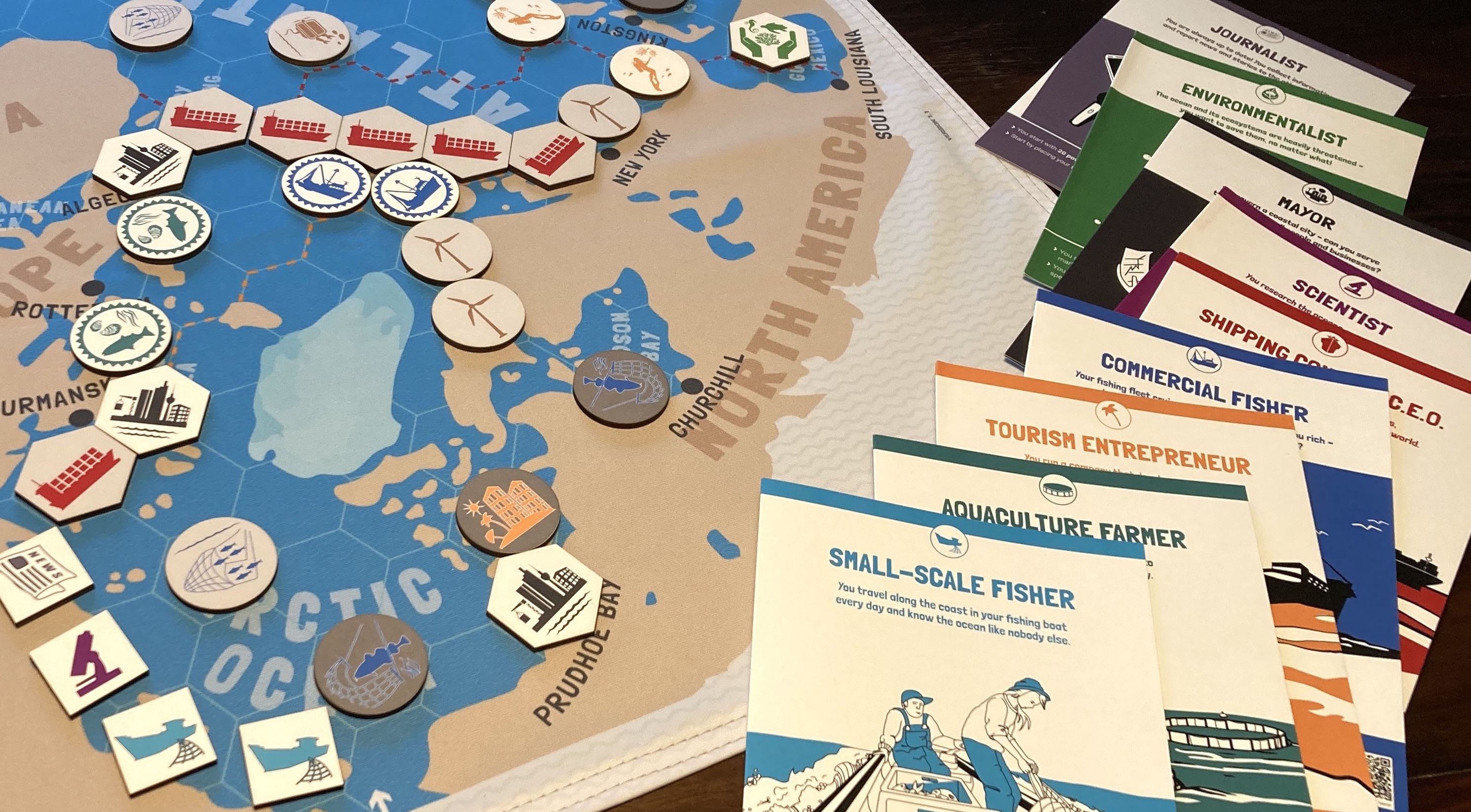
Ocean Limited, a game-based approach to marine sustainability for school classes and environmental education groups (Koenigstein et al. 2020 ICES JMS; www.ocean-limited.com).
 WG Members
  Programme Area