

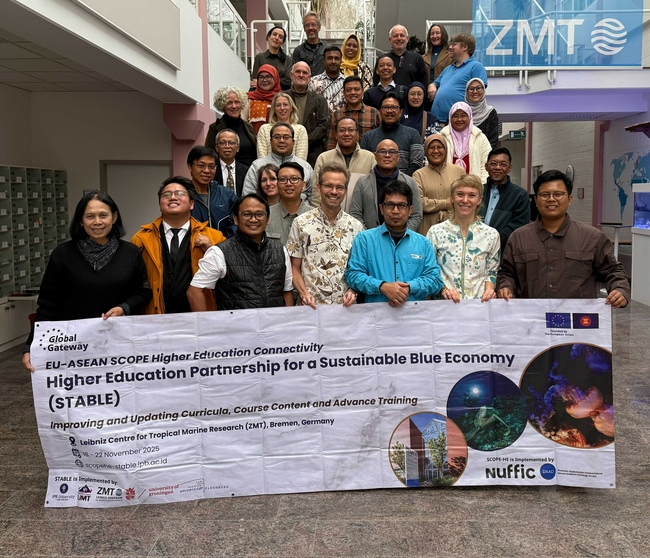
08/12/2025 | The STABLE project “Higher Education Partnership for a Sustainable Blue Economy” is a three-year collaboration (2025 - 2027) that brings together leading universities and research institutions from Indonesia, Malaysia, Germany, and the Netherlands. The goal is to advance and modernise postgraduate education with view to a sustainable Blue Economy. From November 19 to 21, 2025, more than 30 partners within the STABLE project held their second in-person meeting after an initial gathering in Jakarta earlier this year.
Representatives from Indonesia, Malaysia, Germany and the Netherlands came together for a four-day workshop and advanced training. They focused on the development and modernization of postgraduate education on the topic of a sustainable Blue Economy.
A campus tour, interactive exercises and the introduction of the curricula and course contents of the participating institutions laid the foundation for fruitful and inspiring days of exchange and dialogue. Participants intensely discussed how to update and align curricula with emerging priorities such as marine governance, ocean justice and practical Blue Economy skills, both inside and outside of the seminar rooms.
Advanced training sessions introduced cutting-edge tools and methods for research-based teaching, including biodiversity monitoring with eDNA, scientific diving, AI skills and remote sensing, and participatory approaches to coastal management. Researchers and teaching personnel from ZMT, the Universities of Groningen, Oldenburg and Bremen, as well as by the Universiti Malaysia Terengganu (UMT), IPB University (Indonesia) and other invited international speakers shared their knowledge and expertise.
This successful meeting brought the participating institutions closer together and set a strong foundation for the joint activities ahead – including a summer school, field research and joint conferences.
 Contacts
  Programme Areas