

Connecting island communities and marine science: International delegation visits ZMT
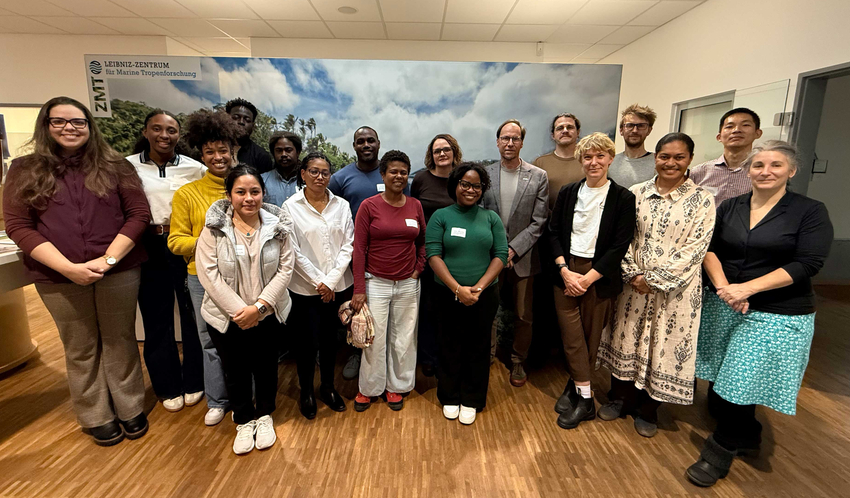
How can marine research help island communities respond to climate change, protect coastal ecosystems and secure sustainable livelihoods? These questions were at the heart of an exchange between ten international guests from Small Island Developing States (SIDS) and other coastal regions and scientists from the Leibniz Centre for Tropical Marine Research (ZMT) in Bremen on 18 November 2026.
For Small Island Developing States, healthy marine and coastal ecosystems are closely linked to livelihoods, economic development and resilience to environmental change. The visit highlighted the relevance of interdisciplinary marine research and cooperation with local communities in addressing these interconnected challenges.
The visit brought together representatives from media organisations, foundations and public authorities to learn about ZMT's research and explore approaches to addressing environmental and societal challenges facing tropical coastal and island communities.
The visit took place as part of the Visitors Programme of the Federal Republic of Germany focusing on Climate change mitigation and adaptation, organised by the Goethe Institute on behalf of the German Federal Foreign Office. The delegation included participants from the Caribbean, the Pacific and other island and coastal regions. The visit and programme were coordinated by Dr Véronique Helfer.
Following a welcome by ZMT's Scientific Director, Prof. Dr Raimund Bleischwitz, researchers introduced projects addressing key challenges for coastal and island regions, including climate change, ecosystem resilience, sustainable tourism and the management of marine resources.
Dr Véronique Helfer presented the EU HORIZON Innovation Action project BEACONSplus, highlighting collaboration with local communities and knowledge integration to strengthen coastal resilience. Dr Jonas Geburzi introduced m-CONNECT, a project developing new management approaches for interconnected tropical seascapes through cooperation between scientists and local communities. Dr Vilane Goncalves Sales presented the project STEPS, focusing on evolving approaches to sustainable tourism.
The delegation also visited ZMT's Marine Experimental Facility (MAREE), gaining insights into the institute's experimental research infrastructure and its marine organisms under the guidance of Silvia Hardenberg.
Further presentations explored groundwater resources on islands, introduced by Prof. Dr Nils Moosdorf, and the use of artificial intelligence and imaging technologies for monitoring and assessing coastal ecosystems, presented by Dr Daniel Schürholz.
Dr Salanieta Kitolelei highlighted the social-ecological importance of reef passages in Fiji, while Rebecca Lahl introduced ZMT's Office for Knowledge Exchange (OKE) and its approach to co-designing research and strengthening societal impact.
The visit concluded with an opportunity for informal exchange between the international guests and ZMT researchers.
 Contacts
 Programme Areas
 Working Groups
 Other relevant links