



WHAT WE DO
Our research develops mathematical and computational models to understand and predict how aquatic ecosystems function and respond to environmental change, connecting processes across scales—from individual cells and physiological processes to populations, communities, ecosystems, and the global ocean. We develop mechanistic, trait-based, and dynamical systems models to investigate how organismal physiology, functional traits, resource-use strategies, species interactions, and environmental variability shape ecosystem dynamics and biogeochemical cycles. By integrating field observations and experimental data with mathematical models, we test hypotheses, identify key mechanisms underlying complex ecological processes, explore nonlinear feedbacks and ecosystem responses, and improve our ability to predict how aquatic ecosystems and their biogeochemical functions will respond to a changing world.
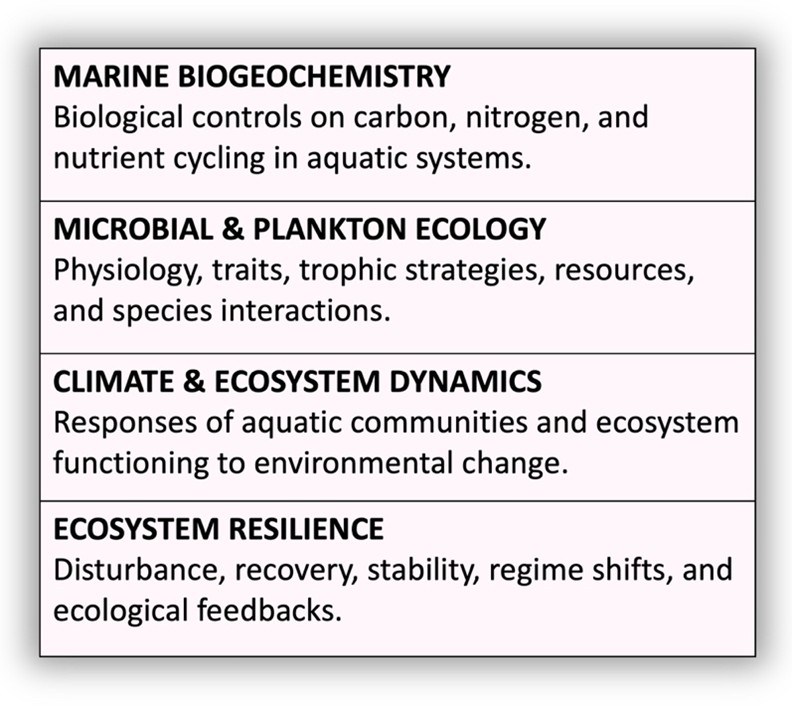
RESEARCH THEMES
RESEARCH HIGHLIGHTS
- Marine Nitrogen Cycle
The marine nitrogen cycle is fundamental to ocean productivity and ecosystem functioning, with microbial processes controlling the availability, transformation, and loss of biologically available nitrogen. Processes such as nitrogen fixation and denitrification are carried out by diverse microorganisms, yet we still have limited understanding of how their physiological traits, resource allocation, environmental conditions, and ecological interactions regulate these processes across different ocean environments. We develop cell-based and trait-based mechanistic models to connect microbial physiology with population and ecosystem dynamics, helping us understand how processes operating at microscopic scales shape marine nitrogen cycling, productivity, and biogeochemical feedbacks at regional to global scales.
- Harmful Algal Blooms
Some phytoplankton species produce toxins and other bioactive substances that can inhibit competitors, deter grazers, and accumulate through marine food webs, with important consequences for ecosystem functioning and human health. Yet the cellular mechanisms controlling toxin production and how these processes influence food-web dynamics remain poorly understood. We develop cell-based and mechanistic models that link environmental conditions, cellular resource allocation, toxin production, and grazing interactions, and scale these processes from individual cells to plankton communities and ultimately the global ocean. Our goal is to understand and predict how harmful algal blooms and their ecological impacts may change under environmental variability and future climate warming. - Coral Reef Ecosystems
Coral reefs are increasingly exposed to warming, eutrophication, pollution, and other interacting stressors, but their capacity to withstand and recover from disturbance remains difficult to predict. We develop mechanistic models that link coral physiology, bleaching, recruitment, and recovery across scales to understand how multiple environmental stressors influence reef resilience and ecosystem functioning. - Plankton Ecology & Trophic Strategies
Plankton drive aquatic food webs, primary production, and major biogeochemical cycles, yet they differ greatly in how they acquire and use resources. We use mechanistic and trait-based models to investigate mixotrophy, resource allocation, trophic strategies, and functional diversity, and to understand how plankton traits shape community structure and ecosystem functioning from local to global scales.
JOIN US
PhD · Postdoctoral · Student projects
We welcome researchers interested in mathematical modelling, aquatic ecology, marine biogeochemistry, and computational science.
 WG Members